Guaranteed
1-There is no cheap way to do content moderation well at scale;
2-It’s not clear how to do it much better at scale with a lot more investment but;
3-It’s guaranteed to be done badly at the level of investment—as a cost center—it gets now.
1-There is no cheap way to do content moderation well at scale;
2-It’s not clear how to do it much better at scale with a lot more investment but;
3-It’s guaranteed to be done badly at the level of investment—as a cost center—it gets now.
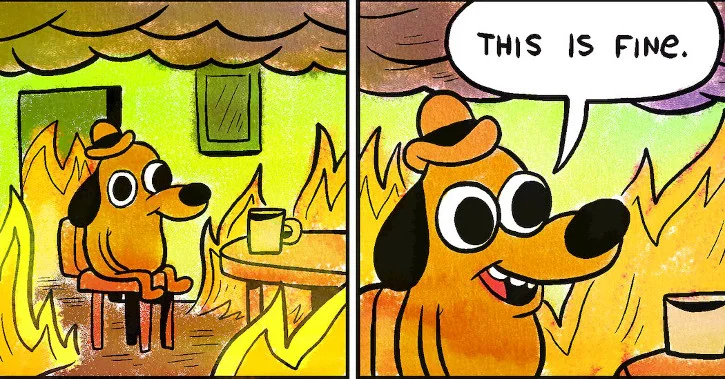
K.C. Green, Gunshow comic #648, January 9th, 2013
There are no easy answers. More important, there are no purely digital answers.
…We didn’t get where we are simply because of digital technologies. The Russian government may have used online platforms to remotely meddle in US elections, but Russia did not create the conditions of social distrust, weak institutions, and detached elites that made the US vulnerable to that kind of meddling.
…Russia did not make the US (and its allies) initiate and then terribly mishandle a major war in the Middle East, the after-effects of which—among them the current refugee crisis—are still wreaking havoc, and for which practically nobody has been held responsible. Russia did not create the 2008 financial collapse: that happened through corrupt practices that greatly enriched financial institutions, after which all the culpable parties walked away unscathed, often even richer, while millions of Americans lost their jobs and were unable to replace them with equally good ones.
Russia did not instigate the moves that have reduced Americans’ trust in health authorities, environmental agencies, and other regulators. Russia did not create the revolving door between Congress and the lobbying firms that employ ex-politicians at handsome salaries. Russia did not defund higher education in the United States. Russia did not create the global network of tax havens in which big corporations and the rich can pile up enormous wealth while basic government services get cut.
…If digital connectivity provided the spark, it ignited because the kindling was already everywhere.
We may be missing F. Scott Fitzgerald’s real message when he wrote, “There are no second acts in American lives.” Maybe he wasn’t saying that we can never recover from early failures.
In a 2010 column in The Atlantic, writer Hampton Stevens pointed out that Fitzgerald wrote for the theater at Princeton and later Broadway (and Hollywood). “With ‘no second acts,’ he was almost certainly referring to a traditional, three-act drama, in which Act I establishes the major conflict, Act II introduces complications, and Act III is for the climax and resolution.”
Fitzgerald may have been saying that, as Americans, we grasp for premature resolutions, impatient with complications along the way. During the second act, the protagonist is unable to resolve the complications because they don’t have the right tools yet. Our lead character must grapple against the odds—often paying a big price along the way. But Americans? Usually, we just want a shortcut.
So how do we, in the scientific world, begin a dialogue with the world of action?
The world of action.
For a room of scientists who prided themselves as belonging to a specialized guild of monkish austerity, this was a startling provocation.
“Few of these policy geniuses were showing much sense. They understood what was at stake, but they hadn’t taken it to heart. They remained cool, detached — pragmatists overmatched by a problem that had no pragmatic resolution. ”
Most everybody else seemed content to sit around.
When the group reconvened after breakfast, they immediately became stuck on a sentence in their prefatory paragraph declaring that climatic changes were “likely to occur.”
“Will occur,” proposed Laurmann, the Stanford engineer.
“What about the words: highly likely to occur?” Scoville asked.
“Almost sure,” said David Rose, the nuclear engineer from M.I.T.
“Almost surely,” another said.
“Changes of an undetermined — ”
“Changes as yet of a little-understood nature?”
“Highly or extremely likely to occur,” Pomerance said.
“Almost surely to occur?”
“No,” Pomerance said.
“I would like to make one statement,” said Annemarie Crocetti, a public-health scholar who sat on the National Commission on Air Quality and had barely spoken all week. “I have noticed that very often when we as scientists are cautious in our statements, everybody else misses the point, because they don’t understand our qualifications.”
These two dozen experts, who agreed on the major points and had made a commitment to Congress, could not draft a single paragraph. Hours passed in a hell of fruitless negotiation, self-defeating proposals and impulsive speechifying. Pomerance and Scoville pushed to include a statement calling for the United States to “sharply accelerate international dialogue,” but they were sunk by objections and caveats.
They never got to policy proposals. They never got to the second paragraph. The final statement was signed by only the moderator, who phrased it more weakly than the declaration calling for the workshop in the first place.
“The first suggestion to Rafe Pomerance that humankind was destroying the conditions necessary for its own survival came on Page 66 of the government publication EPA-600/7-78-019.”
The year was 1979. Rafe Pomerance, trained as a historian, was the deputy legislative director of Friends of the Earth, and this moment marked the beginning of a political and scientific effort that tragically, almost, saved the world.
The quote continues,
Pomerance paused, startled, over the orphaned paragraph. It seemed to have come out of nowhere. He reread it. It made no sense to him.
He proceeded as a historian might: cautiously, scrutinizing the source material, reading between the lines. When that failed, he made phone calls, often to the authors of the reports, who tended to be surprised to hear from him. Scientists, he had found, were not in the habit of fielding questions from political lobbyists. They were not in the habit of thinking about politics.
“For everyone out there who is still operating by the old rules, and keeping their powder dry: This is the fight. You’re missing it. You won’t be remembered as wise for conserving your position later on; it won’t matter. None of it will. The fight is now.”
“If you write out the basic facts of trees, but framed as technology, it sounds like impossible sci-fi nonsense. Self-replicating, solar-powered machines that synthesize carbon dioxide and rainwater into oxygen and sturdy building materials on a planetary scale.”
“Our 6yo asked for a play date with two friends to meet for their book club.
We found out later the book club doesn’t read books. The book club writes books. ”
Owen JJ Stone: Isn't that life, bro?
“One of the weaknesses of game theory as a way of thinking about the world is that it assumes we all know the rules of the game we’re playing. ”
“None of this is fucking real. It’s an entirely made up thing. It’s Piers Morgan, four people with 9 followers and a Russian bot.”
Oh hi. Let’s look at this bullshit article on the BBC website, shall we?
First of all it’s on the BBC so you’re like oh wow it must be a big deal.
You read that there have been calls, calls for Gillette to post an apology video! Damn.
Oh there’s a link to the source. Let’s click on that.
A dude is presenting demands to end the boycott. The demands are the apology video and also that all male employees have to read some mra bullshit, like it’s mao’s little red pill.
So you click on the dude’s profile, wondering who he is and why he can make demands.
This is he. 18 followers. The BBC Just used this person as a source.
And the person who wrote this piece knows the tweet is bullshit, from a bullshit source, because they sure as hell didn’t put the mandatory book reading up on the BBC, they know how stupid that would be.
And yet.
You can construct any fucking narrative by scouring the internet for people claiming something. It doesn't make it relevant. It doesn't make it true.
This is another tweet cited in the article. Eight digits in the handle, fewer followers than I have toes. Gets to represent a "side" in a "controversy".
Have we learned nothing from the past few years? Is this really the best we can do?
We could go on of course. When Piers Morgan dusts off his laptop to plug the week's trending topics into his trusted word document DailyMailPCCultureRantTemplate.docx for his weekly Daily Mail diatribe, the DM uses two tweets to illustrate the article.
13 followers. 4 followers.
And here is Time Magazine. That boycott link? Some dude with 71 followers.
None of this is fucking real. It’s an entirely made up thing. It’s Piers Morgan, four people with 9 followers and a Russian bot.
This isn’t to say it can’t *become* real. These things can snowball. But journalists pushing this duality as a reality are hurting us.
Just a few final points before we let the thread die a well-deserved and long-overdue death.
This is one of those websites that push dubious content. This article has been shared thousands of times on Facebook, into the feeds of thousands more.
It links to the BBC “report”.
So my focus on follower-count was less “high-follower essentialism” as someone put it so beautifully, but rather an attempt to show that we have no way of knowing if these accounts are real much less in good faith.
And serious news organisations should not rely on this shit.
Because an ignored tweet from an account with 18 followers (that has now vanished) should not be a journalist’s core argument on the BBC website, and certainly not be proof of a “major backlash and a wide boycott”.
Note I have no opinion on the ad, its message, the number of dislikes on youtube or whatever.
Just that we rely on journalists to make things clear, to separate truth from lie. This twitter-searching to prop up predefined notions and narratives just adds to the noise.
OK, fin.