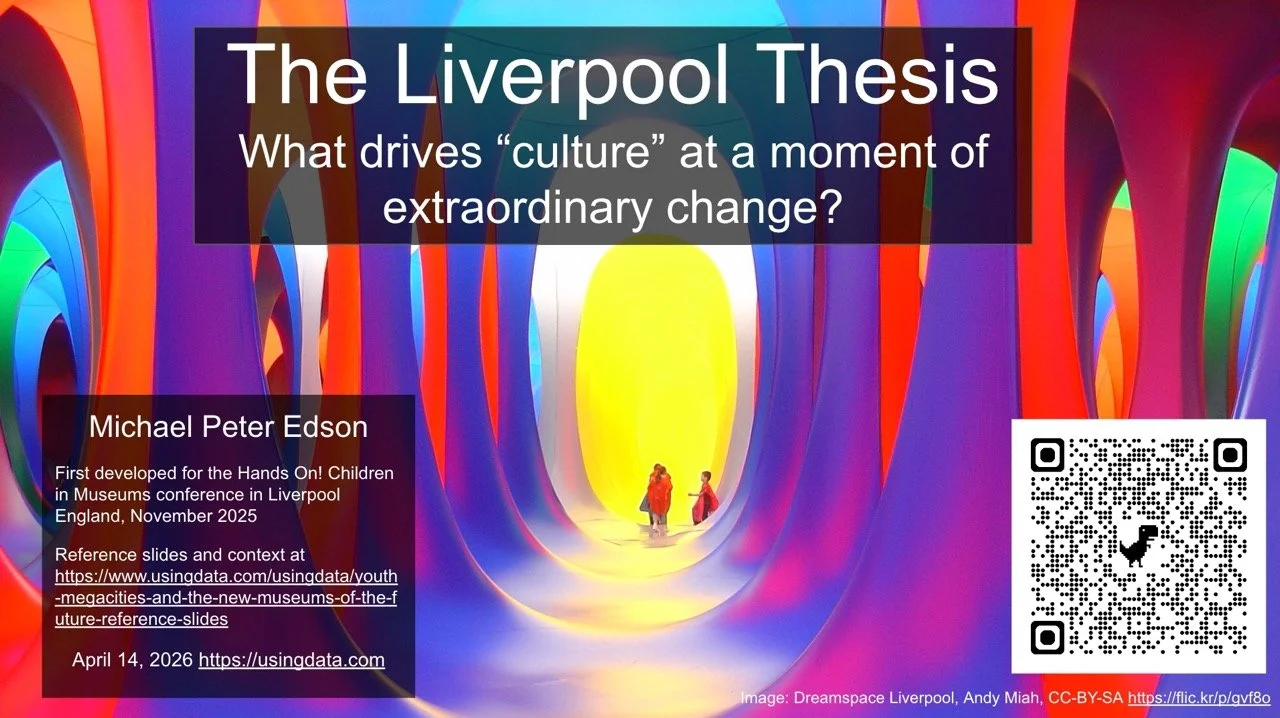
The Liverpool Thesis: What drives "culture" at a moment of extraordinary Change?
Downloads
Reference slides (a longer set of slides with examples, frameworks, and solutions)
//
This is a fleshed-out version of a set of slides I first started working on for the Hands On! Children in Museums conference in Liverpool, England in November, 2025.
Basically, I am asserting that thinking about the world now from the perspective of young people gives us clearer insight into the revolution, disruption, and “derangement” (a term from Amitav Ghosh: our inability to grasp the scale of the climate crisis through our current cultural forms) we now face together.
…And from this perspective it’s easier to see how institutions (such as “culture”, knowledge, memory…) must now be “places of appearance” — a term from Hannah Arendt — where a people can constitute their agency to build a better world.
Here’s the thesis, in a nutshell:
Cultural Revolution — We are living in the middle of a cultural revolution, not yet usefully described in the public sphere, that is driving a wedge between citizens (adults), young people, and a future that is joyous, sustainable and just.
Ruptures – The cultural revolution consists of ruptures in values, knowing, and power. This creates a derangement that we feel in civics, democracy, and everyday life.
Drivers — These ruptures are more than mere politics and norms: they arise from a violent confluence: a “phase change” in our relationship to the biosphere, the social sphere, and technology. This creates an “age of consequences” in which the presumption of a stable, predictable world is gone.
Institutions — In this deranged moment, institutions — our intermediaries of culture and power (such as the “cultural sector”, broadly defined) — must be our allies in natality, building our capacity to create new worlds through actions and speech. Without this we are stranded between the world that has passed and the one that will, by necessity, be born.
The Global Street — This drama of revolution, rupture, derangement, and rebirth is now playing out on the global street of global cities. The future will be won or lost here, where “culture” helps to constitute, or fails to constitute, our right to stand together as authors of a better world.
These points build on the elegant, powerful ideas of Amitav Ghosh, Saskia Sassen (the global city, global street), Hannah Arendt (natality and places of appearance), and Donella Meadows (systems change), among others.
More on LinkedIn (link)…
What Are We Missing? Libraries and AI
Computers In Libraries 2025. Leslie Weir and Claire McGuire on stage with Erik Boekesteijn on the video link, Washington, DC. CC-BY
Updated March 30, 2025 at 4:27pm EST.
(Notes and references are at the bottom of the post.)
What Are We Missing? Libraries and AI? (Google Slides or pdf) was my short provocation for the March 27th Computers in Libraries keynote panel.
I made the following 5 assertions regarding the library sector’s response to AI.
At the heart of librarianship is a Jeffersonian/Franklinian bond between a librarian and a citizen.*
This bond serves a profound purpose in democracy & human rights.AI, developed by/for narrow, private/governmental interests, drives a wedge between librarian, citizen, and democracy.
We are in the midst of a cultural revolution, not yet usefully recognized by public intellectuals, that cuts at the heart of our Jeffersonian/Franklinian bond. AI is one of the drivers of, and characters in, this revolution.We are only investigating a small subset of AI’s scope and impact.
As we try to understand the impact of AI on our societal purpose, we are making a “thinking error” that restricts our vision: We are primarily considering AI as an assistive technology that helps with our standard modus operandi, which is only a small subset of AI's consequences for librarianship and democracy.We are misjudging the speed of AI’s emergence and the intentions of its primary owners.
AI is emerging fast — more quickly than institutions can typically react; Big Tech has unprecedented power/wealth and a poor track record vis-a-vis culture, democracy, and human rights.We have an obligation to intervene on behalf of our Jeffersonian/Franklinian purpose.
We have the nascent skills, community, and mandate to act, as well as a history of involvement in issues of societal importance.
Action is critically important. See the link below for more info about a "23 Things" for AI.
* For readers not steeped in the lore of American librarianship, Benjamin Franklin is credited as the inventor of the free lending library. Thomas Jefferson advanced the idea that a well-educated and informed populace was essential for the success of a democratic republic.)
Notes and references
Program
Program description (CIL 2025 website), featuring Claire McGuire (IFLA), Leslie Weir (Director of Libraries and Archives Canada and president elect of IFLA), Erik Boekesteijn (National Library of the Netherlands), and me.
Get involved — 23 Things
Climate Things website — a temporary source of information for a possible 23 AI Things project.
Sign up for a newsletter and/or get in touch about 23 AI Things / 23 Climate Things, or anything else… (link to climatethings.org “contact us” and newsletter sign-up form)
My Slides
What Are We Missing About AI? (Google Slides or pdf)
References for the slides
Matrix Diagram (above)
This is the chart I showed to illustrate how we’re primarily talking about AI as an “assistive” technology — basically as an individual/office productivity tool, while more-or-less ignoring AI that has a higher level of cognitive ability/utility or a broader scope of societal impact. Here’s the full chart in various manifestations on Google Sheets.
I used the following resources to come up with these hierarchies,Ben Dickson, "The Different Types of AI: From Assisted to Superintelligence," VentureBeat, May 19, 2023. https://venturebeat.com/ai/the-different-types-of-ai-from-assisted-to-superintelligence/
"Types of Artificial Intelligence," Tpoint Tech, accessed February 27, 2025. This resource includes a categorization of AI based on functionalities like reactive machines, limited memory, theory of mind, and self-awareness. https://www.javatpoint.com/types-of-artificial-intelligence
Stuart Russell and Peter Norvig, Artificial Intelligence: A Modern Approach (4th Edition) (Pearson, 2020). This textbook, apparently a classic, discusses different levels of AI based on their capabilities, including distinctions between narrow AI, general AI, and superintelligence. Google Books: https://books.google.com/books/about/Artificial_Intelligence.html?id=Na8rAAAAQBAJ
Other works referenced and cited
Yuval Harari, Nexus (2024). (Author’s site.)
Makes a case for the profound “differentness” of AI the role it will play in shaping how we think, create communities, and discern “truth.”Shoshana Zuboff, Surveillance Capitalism (2018). (Wikipedia page for the book.)
A searing description of the degree to which big tech seeks to usurp the public sphere and the public’s “right to the future tense.” This is a monumental work.Katie Conger and Ryan Mac (NY Times reporters), Character Limit: How Elon Musk Destroyed Twitter (2024). (Wikipedia page for the book.)
Documents, in day-by-day detail, Musk’s conduct and decision making. Chilling.Donella Meadows, Leverage Points: Places to Intervene in a System (1999). (PDF)
One of the most important (and best written!) essays I’ve ever read. Meadows is one of the founders of systems thinking.The Web We Want, Dealing with the Dark Side of Social Media (my presentation from 2019, which delves into the sins of corporate social media.)
Society is more than a Bazaar (a list I put together in 2018 showing 30 links/references and quotes about the dark side of social media and the transgressions of the big platform owners).
Enshittification, Cory Doctorow’s analysis of “platform rot” — why commercial platforms like Amazon, Facebook/Instagram, and TikTok get worse over time. Wikipedia: https://en.wikipedia.org/wiki/Enshittification, and Cory Doctorow’s original article, a must-read: https://pluralistic.net/2023/01/21/potemkin-ai/#hey-guys
Opinion: What Elon Musk Wants. Interview with Kira Swisher. Ezra Klein Show, New York Times, March 7, 2025. (Soft paywall, also available on YouTube.) Very good for its insights about the thought process and motivation of Silicon Valley’s tech elites.
Opinion: The Government Knows AGI Is Coming. (Soft paywall.) Ezra Klein, New York Times, March 4, 2025.
Valuable for its sober insistence that artificial general intelligence will arrive in the next 3 years, during the Trump administration.Six Thinking Hats by Edward de Bono (1985). (Wikipedia page for the book.) Very useful (and beautifully, unusually written) treatise on improving thinking in groups.
How to Think Like a Philosopher by Julian Baggini (2023). (U Chicago Press.) I found this very useful, and delightful to read, regarding how to think more clearly about difficult ideas (and how to recognize and intervene when thinking mistakes are made).
Anything else? Feel free to ask!! (Link to my contact me page.)
Leaving Mumbai
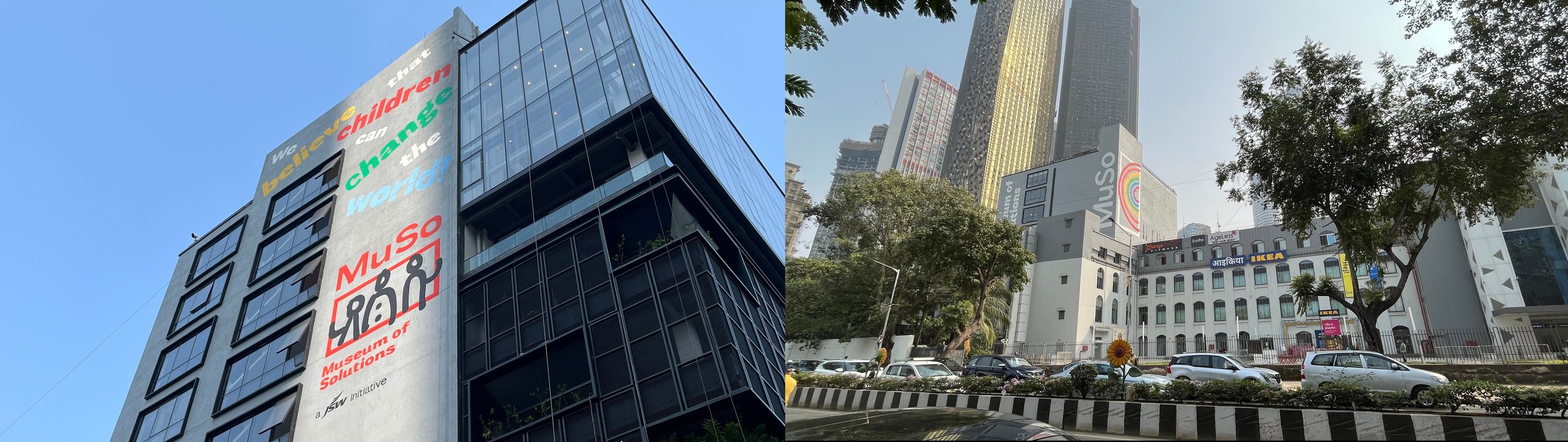
After 4 years on the project and a year as Director I’ve packed my bags and said goodbye, for now, to my fabulous friends, colleagues and community at the Museum of Solutions (MuSo), Mumbai. Thank you! I am overwhelmed by your kindness and generosity and I’ve learned more from you than you’ll ever know!
It was a privilege to help nurture this new museum and its library (LiSo, the Library of Solutions) from concept to reality; to help build and lead the founding team; and to welcome tens of thousands of visitors to our new state-of-the-art building — “a world-class space to champion the art of finding solutions,” as a reviewer at Condé Nast Traveler recently put it — unique in Mumbai and India, if not the world.
Four years ago Tanvi Jindal, MuSo’s founder, asked if I would help her think about a new “museum of solutions” she was envisioning for the site of an old industrial building in the middle of Mumbai.
How could we create a new kind of museum in one of the world’s largest and most challenging cities to catalyze action for the U.N. Sustainable Development Goals, foster new approaches to education, and help young people make meaningful change in the world together?
…And could we also make it fun?
Though Mumbai and India were new to me, this question of museums, play, and civic impact was not. Through years of work with the Smithsonian Institution, the U.N., and other cultural and civil-society conveners around the world I’ve been part of a decades-long movement to *flip the script* on traditional museum practice and help people use their own cultural institutions as platforms for the public good.
And this moment demands nothing less.
With a population of 22 million, Mumbai is indicative of the world’s 40+ megacities (cities with over 10 million inhabitants). Along with megacities like Shanghai, Jakarta, Paris, and L.A., Mumbai is home to daunting social and environmental problems — as well as astonishing creativity and drive. But the problems and the vitality often seem to live in different worlds.
Mumbai is India’s financial capital but over half of its residents live in slums. It is India’s innovation and creative hub (Bollywood! The city of dreams!) but many of its neighborhoods will be underwater by midcentury, drowned by rising seas due to climate change. Education is highly valued, but it is predominantly structured around rote memorization and test achievement, not the world as we see it today.
Young people are often caught in the middle of this dynamic, squeezed between a daily fight for survival, antiquated educational and social systems, and their own profound abilities to see and create a future filled with beautiful change.
Furthermore, young people — all people — have a fundamental human right to be involved in the decisions that will affect their futures, but too few conveners will help them find their way.
If we can learn to solve problems in places like Mumbai we stand a good chance of surviving and thriving in the 21st century. Museums like MuSo can be a kind of civic infrastructure in this regard. By being bold, inclusive, and action-oriented — rooted in reality but also participatory and fun — we can bring people together to build social capital and elevate everyone’s ability to imagine and build a future that is joyous, sustainable, and just.
What’s next for me? I don’t know — I’m still catching up on sleep and processing what I’ve learned! But with any luck, I’ll keep working in this direction: young people and their grownups in vital civic spaces, enthralled by the chance to play and explore together — making life better one small solution at a time.
//
This text is a slightly expanded version of this post on LinkedIn.
Links/references for Living With War and the Lianza New Zealand National Library Conference
Ahiahi pai to all of you at the Lianza 2023 New Zealand library conference (October 31)!
And greetings to my colleagues at the Living with War conference in The Hague (November 3rd)!
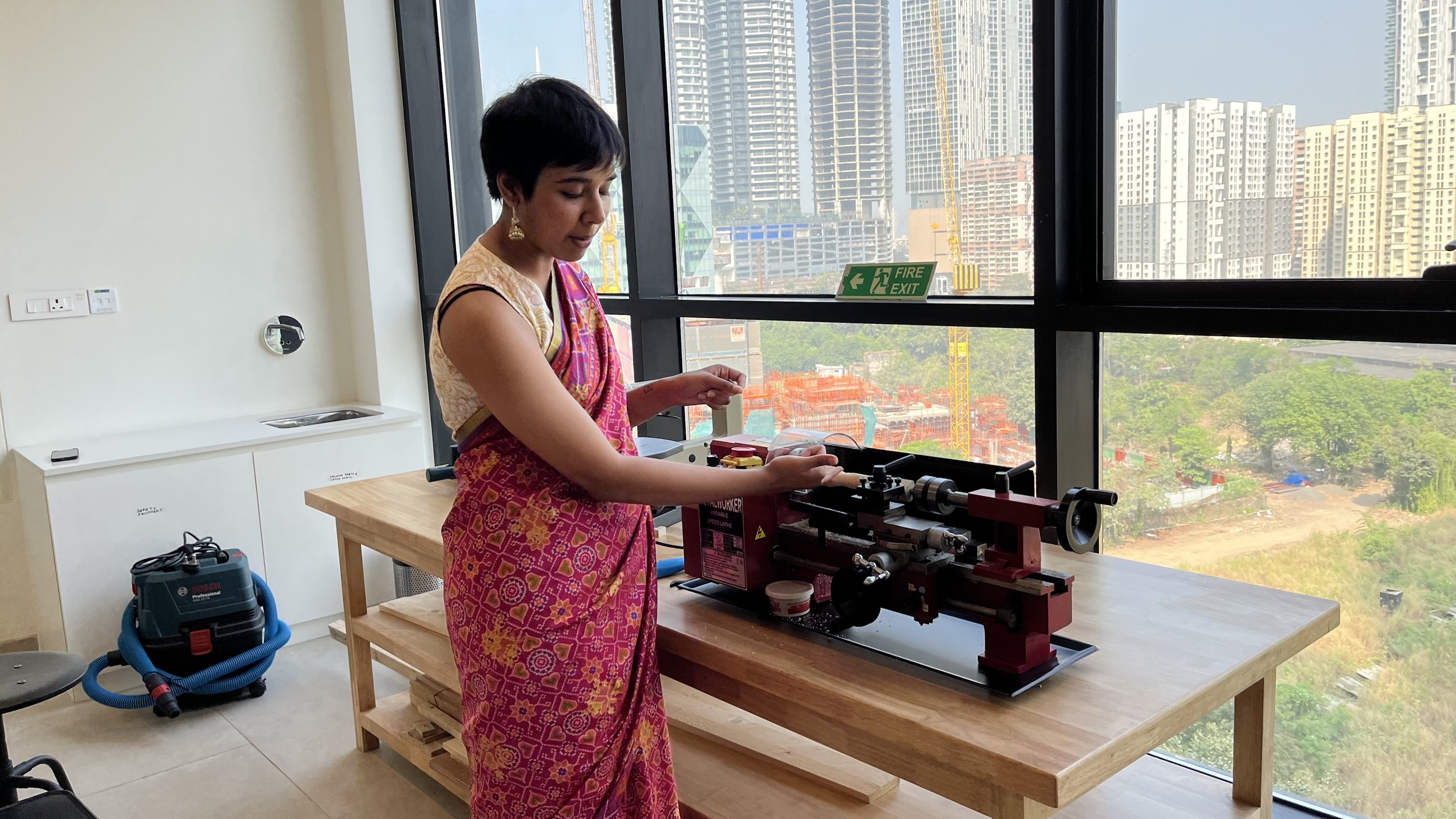
For the Lianza conference I’ll be joining you from from inside the wood fabrication shop in the 10,000 square-foot Make Lab of the soon-to-open Museum of Solutions, Mumbai! And on November 3 I’ll be with you in person in The Hague for Living With War.
We are opening in November and we’ll be releasing more info, teasers, and events info very soon!
(You can check out our Instagram {the main platform in India} and website now for some sneak peeks of the building, program, and philosophy. Here’s a short post (about my joining the team) that gives a good short overview of the project. LOL see below for a special personal photo album treat.)
Links and notes related to my talk
Photos — Some photos of the site, construction, and goings on here.
Climate Things — I mentioned the Climate Things initiatives, 23 Climate Things and the Culture for Climate Innovation Prize. We would love to have you all involved - - so drop us a note and let us know how we can help! Special shoutout to the great Erik Boekesteijn (who I believe is with you there today?! Hi Erik!), Jan Holmquist and Julia Matamoros who are bringing their tremendous passion and expertise to the project, and of course our initial group of funders/supporters.)
Culture, climate, and The Big Frikin Wall —This talk was a super-short “reduced Shakespeare” version of longer, more detailed work on the subject of updating library practice and The Big Frikin’ Wall, so here is some more detailed work if you’d like to dig in.
MuseumNext Interview: Culture, activism, and the big Frikin' Wall - a long interview with me about these ideas
Video and slides/links for NEMO webinar, Create Dangerously: Museums in the Age of Action - tons of notes, references, and a 45 minute webinar version of these ideas from the Network of European Museum Organizations. (Also a keynote talk from the NEMO 2022 conference in Lisbon.)
Notes from Digital, Culture, and the Transformation of Europe - a cool set of slides presenting the outcomes/synthesis of a 2021 workshop with library and museum/cultural leaders in Leiden, The Netherlands
…More coming soon. Got to watch the conference talk now!
MuseumNext Interview: Culture, activism, and the big Frikin' Wall
Jim Richardson and Tim Deakin published a long interview with me on the MuseumNext website in advance of the Green Museum Summit.
He explains to MuseumNext why the landscape has changed for museums and how passivity is no longer an option in the face of urgent issues like climate change. Instead, he advocates for new and dynamic forms of activism in order to have a “consequential impact on the course of the Anthropocene”.
"Digitality" references for MuseumNext and Computers In Libraries
This week I’ll be speaking at the MuseumNext Green Museums Summit and Computers In Libraries (two separate conferences) about “digitality” and climate action in the cultural sector.
Here’s the gist of it: The climate emergency asks museums, libraries, and other heritage, knowledge, and memory institutions a series of tough questions about their purpose and relevance in society. How big can they work? Who do they involve? Who do they serve?
Compared to the scale and speed of the climate crisis and the mind-blowing scope of what we must accomplish together in the next 10, 20, and 30 years, what can the cultural sector do?
These questions are hard to discuss within the cultural sector. Though the humanistic, prosocial values in the sector are strong the sector’s institutions, in particular, are wary of disruption and have evolved to think in conservative, risk-averse ways. But the climate emergency acts like an X-ray or lie detector on institutional thinking, revealing gaps between values and practice that might go unnoticed when working on smaller concerns.
One of those gaps has to do with digital. Digital is currently a blind spot in our thinking about climate action, and in both of these talks I’ll argue that the museum and library sectors are operating with a confused and outdated concept of digitality that impedes our ability to think clearly about the kinds of impact we are obligated to create. An updated concept of what “digital” means in the 2020s — new tools, new skills (and learning to appreciate neglected old tools and skills) and a new understanding of the digital public sphere are all needed to help us find a new direction and unlock new capabilities within the sector and in the communities we serve.
But (or perhaps, and), going there — having a solid conversation about what digital is and can do requires us to question some tightly held assumptions about trust, disruption, and power.
Below are links to slides, references, and other useful/relevant information cited in the talks.
I’ll post slides transcripts from these talks ASAP.
Resources mentioned in the talks
Updates
From the Computers in Libraries Q&A:
Complicating the Narratives: What if journalists covered controversial issues differently — based on how humans actually behave when they are polarized and suspicious? Amanda Ripley, Solutions Journalism Network, 2018.Long Twitter Thread: “I’ve been thinking a lot about digitality recently…”
General intro stuff from first 10 minutes
The Year Man Becomes Immortal, Time.com (2019) — The Law of Accelerating Returns
A Weasel Just Shut Down The Large Hadron Collider, Business Insider, 2016)
The Big Frikin’ Wall, Adapted from Kathy Sierra. Notes here.
Serious in Singapore, New York Times, Tom Friedman (2011)
Winning Slowly Is the Same as Losing, Bill McKibben, Rolling Stone (2017)
Only 11 Years Left to Prevent Irreversible Damage from Climate Change, Speakers Warn during General Assembly High-Level Meeting. General Assembly, High-Level Meeting on Climate and Sustainable Development (2018)
No One Is Too Small to Make a Difference, Greta Thunberg (2021, also cited below)
When It’s Too Late to Stop Fascism, According to Stefan Zweig, George Prochnik, New Yorker (2017)
Aditi Juneja: “If you’ve wondered what you would’ve done during slavery, the Holocaust…you’re doing it now” (2017)
European climate and recovery initiatives
The European Commission has put €1.8 trillion on the table for the next 6 years’ work on The New European Bauhaus, pandemic recovery, and European Green Deal.
New European Bauhaus
A new EU initiative launched in 2021 to be the cultural front-end for the European Green Deal. “The New European Bauhaus initiative calls on all of us to imagine and build together a sustainable and inclusive future that is beautiful for our eyes, minds, and souls. Beautiful are the places, practices, and experiences that are: Enriching, inspired by art and culture, responding to needs beyond functionality; Sustainable, in harmony with nature, the environment, and our planet; Inclusive, encouraging a dialogue across cultures, disciplines, genders and ages.”Pandemic recovery
€807 billion for 7 priority areas, including cohesion, resilience, natural resources/environment.Green Deal
Targets 55% reduction in greenhouse gas emissions by 2030, and by 2050: “economic growth decoupled from resource use”, carbon neutral, and “no person and no place left behind”.
Workshop notes (Digital, Culture, and the Transformation of Europe)
Product Pinocchio, via GameStorming
Farhad Manjoo: “A bag of mixed emotions”
Why Tech Is Starting to Make Me Uneasy, Farhad Manjoo, 11 October 2017.
“In 2007, when Mr jobs unveiled the iPhone, just about everyone greeted the new device as an unalloyed good. That's no longer true. The state-of-the-art, today, is a bag of mixed emotions. Check might improve everything. And it's probably all so terrible in ways we're only starting to understand.”
Reactions to Trump withdrawing the US from the Paris accord
Trump Will Withdraw U.S. From Paris Climate Agreement, New York Times, 1 June 2017.
Symposium: What is the museum’s role in a burning world? Politiken, 27 June 2017 (see also slides in bullet below)
Field Museum and Natural History Museum response — see slide 89 of Shaking Hands with the Future: Museums and Heritage at a Moment Full of Change (this link will take you right there)
Teen Vogue, Weather Channel, Steak-Umm — slides 90 - 100. Here’s an interview with Steak-Umm Social Media Manager Nathan Allebach (2018)
Museums and libraries fight ‘alternative facts’ with a #DayofFacts, Washington Post, 17 February 2017
Pew Research
I cranked through about 10 years of Pew Research Center reports in trying to figure out the evolution of our concept of digitality over the years. The first link, Visions of the Internet in 2035 | Pew Research Center, was particularly useful for gaining some insight into how “experts” conceptualize the role of information technology in society. That being said, I was dismayed, but not surprised, to see so few mentions of the climate emergency in any of these reports. Overall, these Pew reports reminded me of how essential and empowering the Internet is in so many people’s lives.
Here are a handful of the most useful reports. The full list is on this spreadsheet.
Visions of the Internet in 2035 | Pew Research Center (2022)
How Gen Zers, Millennials react to climate change content on social media | Pew Research Center (2021)
The future of democracy and civic innovation | Pew Research Center (2020)
Predictions from experts about the next 50 years of digital life | Pew Research Center (2019)
Activism in the Social Media Age | Pew Research Center (2018)
“Cataloging projects”
I put this spreadsheet together after reviewing 1000 pages of my own notes on digitality, 30+ reports from the Pew Research Center from the last 10 years, and notes from our November 2021 workshop on cultural-sector climate action.
There are three tabs
References lists 323 digital-related sites, apps, technologies, concepts, patterns, phenomena, and attributes that I’ve tagged, subjectively, with some adjectives like prosocial, civic, empowering, and dangerous.
Sorted by tag count shows each tag on its own column, and then a list of all the digital-related things that have that tag. You can hover your mouse over each cell to see a note and link (if there is one)
Link to sources shows a list of 89 articles, books, and references mentioned on the References tab
The empowering side of digitality
See the “empowering” projects in the first column here (Google Sheets).
Slides: Dark Matter (2014)
Slides: The Age of Scale (2013)
The Dark Side
Slides (with lots of links and references): The Web We Want, Dealing with the Dark Side of Social Media (2020).
Also this Ignite Talk for the Museum Computer Network conference (video, 2019)
Disruption Theory
What Is Disruptive Innovation? Christensen, Raynor, McDonald, Harvard Business Review (2015)
The Innovator's Dilemma, Clayton Christensen, (2003 reprint)
Video book summary: The Innovator’s Dilemma by Clayton Christensen (2015)
Lecture: Clayton Christensen, The Innovator’s Dilemma (2016)
Books, Articles, Videos
A big long list of relevant resources in this spreadsheet here, and a handful of the most relevant below.
No One is Too Small to Make a Difference, Greta Thunberg (2021)
Hot Money, Naomi Klein (2021)
Digital Democracy, Analogue Politics: How the Internet Era is Transforming Politics in Kenya, Nanjala Nyabola (2018)
What is Web 2.0? Design Patterns and Business Models for the Next Generation of Software, Tim O’Reilly (2005)
The Wikipedia Revolution: How A Bunch of Nobodies Created The World's Greatest Encyclopedia, Andrew Lih (2009)
Here Comes Everybody: The Power of Organizing Without Organizations, Clay Shirkey (2008)
Twitter and Tear Gas: The Power and Fragility of Networked Protest, Zeynep Tufekci (2018)
“I was made for the library, not the classroom. The classroom was a jail for other people’s interests. The library was open, unending, free. ”
“Damn, library Twitter rolls hard”
“They treated me as another reader – nothing less or more – which meant they treated me with respect. I was not used to being treated with respect as an eight-year-old”
“It’s really based on an analogy, if you will: that seemed to work in other times - that the idea of having access to the collective works of humankind has been a win.”
The full quote:
Ken Garrison: When I was telling my wife about what I was going to be talking with you about, she had a naïve but kind of profound question, which is “Why are you doing this? Why are you trying to archive the entire world and the entire internet?”
Brewster Kahle: It’s really based on an analogy, if you will: that it seemed to work in other times - that the idea of having access to the collective works of humankind has been a win. So, we all look back to the Library of Alexandria. And by going and pulling together the works from all over the world and translating them then into Ancient Greek, they were able to come up with fantastic discoveries. They knew how big the world was. They knew it was round. They knew how big it was within a couple percent. Euclid authored “Elements,” which is what it is I still studied as geometry in high school. So, fantastic things can come of it if you can leverage the works of other people. And the reason why I got involved in the whole area of building the library back in 1980 was just kind of on that analogy and the thought that technology allows us to do this and it seems like a good thing to do.
UNYPL
July 2012 Highlights from the Underground New York Public Library
Each one was its own moment. It’s great to see them all together.
1. “The God Delusion,” by Richard Dawkins 2. “The Birth of Tragedy,” by Friedrich Nietzsche 3. “Mary Poppins,” by Dr. P. L. Travers 4. “The Stranger Beside Me,” by Ann Rule 5. “Queer,” by William S. Burroughs 6. “Just My Type: A Book About Fonts,” by Simon Garfield 7. “By Grand Central Station I Sat Down and Wept,” by Elizabeth Smart 8. “Know Thyself,” by Na’im Akbar 9. “Star Wars (The Old Republic): Fatal Alliance,” by Sean Williams 10. “Dinner at the Homesick Restaurant,” by Anne Tyler
I’m looking forward to the new characters who will come with their books to the Underground New York Public Library in August!
The Public Domain
“The internet gives access to the digitised portion of that knowledge and creativity on a scale previously impossible. It is the driver for massive digitisation efforts that will fundamentally change the role of cultural and scientific heritage institutions. The digitisation of analogue collections creates new opportunities for sharing and creative re-use, empowering people to explore and respond to our shared heritage in new ways that our legislation has yet to catch up with. It has also brought copyright to the centre of attention for holders of our cultural and scientific heritage. Our memory organisations have for generations had the public duty of holding the heritage in trust for the citizenry and of making it accessible to all. Both of these functions are usually conducted at the citizens’ – i.e. the tax payers’ – expense.”
The charter continues,
Entrusted with the preservation of our shared knowledge and culture, not-for-profit memory organisations should take upon themselves a special role in the effective labelling and preserving of Public Domain works. As part of this role they need to ensure that works in the Public Domain are accessible to all of society, by making them available as widely as possible. It is important for memory organisations to recognise that as the guardians of our shared culture and knowledge they play a central role in enabling the creativity of citizens and providing the raw materials for contemporary culture, science, innovation and economic growth.
“Arguments concerning the opportunity cost of open access (giving away potential revenues, for example) are based less on specific examples than on hypothetical opportunities — “the magic app” — that frankly never materialise.”
“The non-commercial clause that has governed use and re-use of the Museum’s metadata is rooted in the belief that non-profit academic charities should enable free use only for non-profit purposes. But in the digital age, with evidence that use and re-use can increase knowledge when it is openly linked across the entire web, the new view is that data funded by the taxpayer should have the broadest possible distribution.”
“It turns out to be surprisingly hard to convince (some) people that the very best thing to do with the treasures of the world is to give them to the world.”
The comment continues,
It turns out to be surprisingly hard to convince (some) people that the very best thing to do with the treasures of the world is to give them to the world. So many of them [museums and other collecting institutions] are so fixated on ‘ownership’ that they just can’t let go. Hopefully, they’ll all die off soon and the generation now growing up will take a more mature approach — that is, they’ll realize that everything from academic papers to great art belongs to everyone, and that anyone attempting to claim them for themselves is a hoarder — to be despised, shunned, and overruled.