New Essay — Youth, Megacities, and Culture in the Age of Consequences (Expanded Liverpool Thesis)
I just completed this draft essay / book chapter (below), which explores our obligations as global citizens and museum practitioners at a moment of extraordinary change—an Age of Consequences and cultural revolution.

I’ve been wrestling these ideas to the ground for almost a year now, since preparing for a talk I gave at the 2025 Children in Museums conference in Liverpool (hence the “Liverpool Thesis”), and this my most thorough and detailed effort so far, with a long bibliography and a long-long list of citations.

Note that this is my unedited, Author’s Original Manuscript (AOM) for a chapter in a book to be published in 2027 by IKTF, the Institute for Cultural Participation Research / Instituts für kulturelle Teilhabeforschung and Transcript Verlag, Germany. The book is an anthology from the 2025 “Children in Museums” Connected Audience conference in Liverpool, England, with a working title of Culture & Young People – What Could Possibly Go Wrong? The anthology will be edited by Vera Allmanritter and Julia Glesner.

This essay is CC-BY-NC-SA Michael Peter Edson, August 23, 2026.

Here’s the Intro below, or you can jump to the full essay on a new page

Introduction

At the 2023 opening gala for the Museum of Solutions in Mumbai (MuSo) I approached a middle-aged guest and asked how he was enjoying the evening.

“I am angry,” he told me. “This museum is a jewel, but where were you 30 years ago when I was a child? And where are you now in the thousands of other places where a museum like this is needed?”

I was surprised and inspired by his response. Surprised, because few people expect a children’s museum to have such significance; and inspired because I felt he had perfectly sensed our purpose and ambitions and he felt they were too small. And I agree with his assessment: indeed, where are we — our sector, broadly writ, of children’s museums and all museums at a moment of extraordinary human and planetary change? Why build a children’s museum in Mumbai at all, or any museum in a world beset by social, technological, and environmental challenges?

Museums evolve in response changes in society. In the 1820s, visitors to the British Museum underwent rigorous personal vetting by the Director before earning a quick, supervised visit to the collection. Two centuries later, the British Museum has a different entry scheme and a different role in the world. But if the purpose and methods of the museum have always been fluid, the question now is whether we can get museum practice and practitioners to change quickly enough to meet a moment of breathtaking biological and socio-technical rupture.

This essay lays out a five-point thesis regarding our current moment in human culture and planetary systems, exploring our obligations as global citizens and museum practitioners, particularly within the discipline of children’s museums:

  1. We are in the middle of anew kind of cultural revolution — an “Age of Consequences” where the compounding effects of choices made across social, technological, and natural systems are becoming the predominant driver of human events.

  2. This revolution and rupture is unfolding everywhere, but it is most acutely seen and addressed in megacities and on the “Global Street.”

  3. Third, within this landscape, young people must be recognized and supported as consequential civic actors with unique rights, stature, and capabilities. This conceptualization of youth is growing globally, and is linked to the “rights of nature” and the “rights of future generations.”

  4. Legacy cultural institutions are structurally “deranged”— hamstrung by twentieth-century habits that leave them ill-equipped to act as authentic allies to youth or relate to the hyper-velocity of rupture beyond their doors.

  5. Museums, libraries, and knowledge/memory institutions must transform themselves into “places of appearance” that constitute the human process of natality (societal rebirth), acting as sites of imagination and renewal where new generations can manifest their agency through speech, presence, and action.

The acceleration of change and the perceived closing off of promising futures have cast new light on rights and capabilities of young people. While the Museum of Solutions (MuSo) in Mumbai was my first direct leadership role in a children’s museum, the experience solidified my belief that this sub-discipline deserves greater visibility and higher stakes. I believe museums, libraries, and other cultural, scientific, and performing arts organizations must now view themselves as essential components of a global response to the Age of Consequences and the project of building a more just, sustainable, and joyous world, with particular attention to the rights and capabilities of young people.

I write this essay not as an academic but as a cultural practitioner, maker, and doer. This perspective is informed by a career dedicated to increasing the openness and democratic vibrancy of cultural institutions and advancing the right to culture, as framed by the Universal Declaration of Human Rights, which includes the right to access and contribute to the cultural and scientific life of the community (United Nations General Assembly 1948). This right is more than symbolic: it is at the heart of our capacity to understand the world we are living in and to make good decisions regarding its future.

Continue reading (jumps to new page)…

Note: this related article, Libraries, AI, and the Age of Consequences, follows a similar thesis but goes into greater depth regarding epistemic attacks on the cultural sector and the posture of libraries and other cultural/knowledge institutions regarding AI.

Preprint article: Libraries, AI, and the Age of Consequences

Libraries, AI, and the Age of Consequences (preprint, author’s original manuscript: html / PDF) is the title of an invited article I’ve just completed for the MDPI journal Future Collections, Libraries, Archives, Museums.

This paper is an expanded and refined version of the keynote address delivered at the World Library Forum at Peking University in Beijing, May 2026, and while it follows the “Age of Consequences” logic/rationale that I’ve been working on for the last year or so this paper is unique in two regards.

First, in addition to the other drivers of revolution, rupture, and Consequences I’ve been putting on the table (climate, biodiversity, AI & computer science, biotech…), I try to document and weave together instances in which libraries, museums, and other memory/knowledge institutions are under assault in the USA and abroad; and second, I’ve gone a little deeper into my working hypothesis about the ways in which AI is “driving a wedge” between librarians and citizens/learners; and how library leaders and practitioners can avoid a series of “thinking traps” that are, in my experience, interfering with our strategic sense-making and foresight.

As I conclude:

From Benjamin Franklin’s creation of the subscription library to Thomas Jefferson’s conviction that a self-governing republic requires an informed populace, the baseline mission of librarianship has always been the protection of open, human epistemic agency. This principle lies at the heart of the cultural professions, and is enshrined in Article 19 of the Universal Declaration of Human Rights and explicitly codified in Target 16.10 of the UN Sustainable Development Goals—a target secured through global advocacy by the International Federation of Library Associations and Institutions. If we think of AI purely as an efficiency tool or a type of seemingly neutral, off-the-shelf software—or even worse, if we reason that we are unprepared or unfit, as a sector, to defend these principles—we abdicate our stewardship of knowledge, culture, and memory to others.

This related essay, Youth, Megacities, and Culture in the Age of Consequences (Expanded Liverpool Thesis), is a preprint “author’s original manuscript” for a chapter in a forthcoming book about children’s museums. Here, I go deep on the drivers and consequences of rupture and revolution, including the importance of young people, megacities, and museums & cultural institutions as “places of appearance” (per Hannah Arendt).


Struggling

“We need [the museum] now because we are in a time of history where the structures, both the UN itself but also the governance structures generally across the world, are struggling. We have systems that are no longer as relevant and as impactful and as ready to take on the problems of today. And [the] UN Live [museum] could be and should be a tool to help rectify that. The way we rectify that is by creating a dialogue — not just between politicians and diplomats but between them and the people that were supposed to serve. And I think it’s incredibly important that those people, every single one of us somehow, has a way to get to the table where decisions are taken.”

— U.N. Under Secretary Michael Møller. UN Museum visioning workshop. Copenhagen, March 2015.

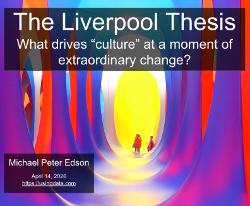
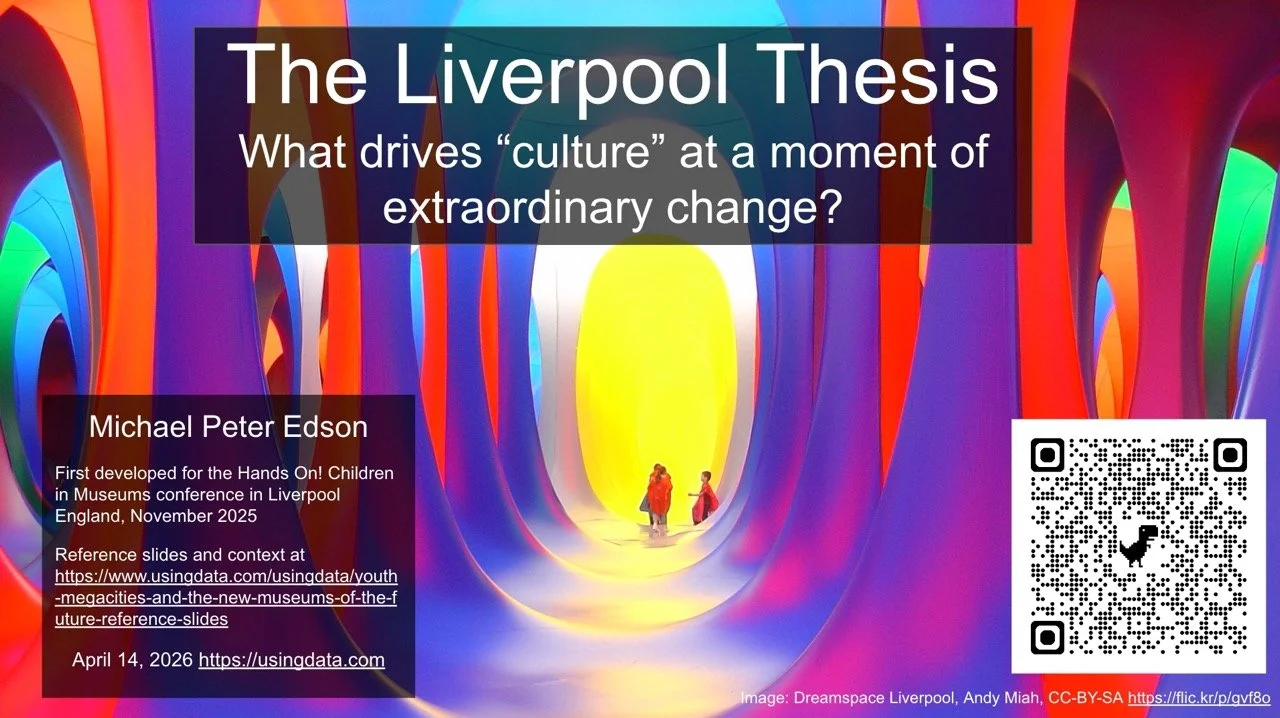
The Liverpool Thesis: What drives "culture" at a moment of extraordinary Change?

Downloads

//

This is a fleshed-out version of a set of slides I first started working on for the Hands On! Children in Museums conference in Liverpool, England in November, 2025.

Basically, I am asserting that thinking about the world now from the perspective of young people gives us clearer insight into the revolution, disruption, and “derangement” (a term from Amitav Ghosh: our inability to grasp the scale of the climate crisis through our current cultural forms) we now face together.

…And from this perspective it’s easier to see how institutions (such as “culture”, knowledge, memory…) must now be “places of appearance” — a term from Hannah Arendt — where a people can constitute their agency to build a better world.

Here’s the thesis, in a nutshell:

  1. Cultural Revolution — We are living in the middle of a cultural revolution, not yet usefully described in the public sphere, that is driving a wedge between citizens (adults), young people, and a future that is joyous, sustainable and just. 

  2. Ruptures – The cultural revolution consists of ruptures in values, knowing, and power. This creates a derangement that we feel in civics, democracy, and everyday life.

  3. Drivers — These ruptures are more than mere politics and norms: they arise from a violent confluence: a “phase change” in our relationship to the biosphere, the social sphere, and technology. This creates an “age of consequences” in which the presumption of a stable, predictable world is gone.

  4. Institutions — In this deranged moment, institutions — our intermediaries of culture and power (such as the “cultural sector”, broadly defined) — must be our allies in natality, building our capacity to create new worlds through actions and speech. Without this we are stranded between the world that has passed and the one that will, by necessity, be born.

  5. The Global Street — This drama of revolution, rupture, derangement, and rebirth is now playing out on the global street of global cities. The future will be won or lost here, where “culture” helps to constitute, or fails to constitute, our right to stand together as authors of a better world.

These points build on the elegant, powerful ideas of Amitav Ghosh, Saskia Sassen (the global city, global street), Hannah Arendt (natality and places of appearance), and Donella Meadows (systems change), among others.

More on LinkedIn (link)…

Reference slides for Hands On! conference talk: Youth, Megacities, and the New Museums of the Future

Update: Here’s a shorter set of slides — a kind of prequel focusing in on the revolution and drivers that necessitate a change in cultural strategies. Liverpool Thesis: What drives "culture" at a moment of extraordinary Change?

//

A long, excruciatingly comprehensive set of “reference slides” (and work in progress) from my short, November 2025 talk at the Hands On! Conference at the Eureka! National Children’s Museum conference Liverpool.

At some point I’ll boil this down into a shorter, 20-30 slide summary but for now I wanted to try to lay out the whole case in all its glory, warts and all.

Download/view

PDF
Slides (via Google Slides)

Contents

  1. Intro/overview: Why build a children’s museum (or any kind of museum) now?

  2. Interlude — 3 stories

  3. The world we live in — cultural revolution and axiological rifts

  4. What does this mean for young people?

  5. What does this mean for our institutions and practice?

  6. Change is possible

  7. Questions I often get at this point

  8. Helpful frameworks (tools for thinking and working together)

    The Big Frikin’ Wall; Zuckerman Quadrant; Think Big, Start Small, Move Fast, Activism, & etc

    The emergence of children’s rights and the rights of future generations

    Leverage Points in a System (Donella Meadows)

  9. Examples - real-world inspiration (~60 projects)

  10. Current work – bringing the vision to scale

  11. Conclusion

More context (cross post from LinkedIn)

Reference slides for "Youth, Megacities, and the New Museums of Tomorrow" — a short talk I gave at the Hands On! - International Association of Children in Museums conference in Liverpool in November.

I'm arguing here...laying out the evidence and rationale...that we are in the midst of a cultural revolution — a "phase change" in the functioning of the world — that is driving a wedge between young people and their human right to shape and enjoy a common future.

These changes affect all of us profoundly, and in response, I think that children's museums — all knowledge, memory, and "cultural" institutions, really — need to dramatically reconsider their purpose, scope and methods.
We need to up our game, and fast.

As Greta Thunberg told the European Parliament in 2019, seemingly a thousand years ago, "Everyone and everything has to change. But the bigger your platform, the bigger your responsibility. The bigger your carbon footprint, the bigger your moral duty."

C02 is a big driver of the cultural revolution(s) and "rift" but as I see it, the main challenge lies in the combinatory effects of climate change and biodiversity loss, digital (Big Tech) and biotech, concentrations of wealth and power, and the advent of a new kind of change (accelerating, tipping points, delays between cause and effect) that exceeds our human capacity to think, learn, and make wise decisions in an era that needs, as Zeynep Tufekci says, "all the sociological imagination we can get."

That's *a lot* to take in. It's a big problem space and a big "ask" to figure out a new way to work and act in such an uncertain time. But the great systems thinker Donella Meadows observed that paradigms in transition are actually easier to change.

And the good news is that there are loads of inspiring, practical examples to draw from for those who have the curiosity and imagination to think about our institutions and practice in new way. I've included over 60 examples of projects, exhibits, and strategies in these reference slides as well as a dozen or so frameworks and "thinking tools" that I've found particularly useful over the years.

What is the road ahead? I think it's to move beyond the idea that young people are small "future adults" to be educated and toward the idea that young people are legitimate and forceful civic actors with the rights, capabilities, and moral standing to shape the world on their own terms.

But to achieve this paradigm change, young people everywhere need dramatically better allies and institutions from the world of adults, and there are lessons here for all of museum and cultural practice.

"I came away both slightly terrified about the world young people are growing up in and inspired to do something about it" is how session chair Nick Woodrow, a Board member at Eureka! described my talk, and terrified and inspired is how I feel too ;)

Link to U.N. Museum TEDx talk

For the convenience of some new collaborators, I dumped the video and transcript of my 2016 TEDx talk about the Museum for the United Nations onto a convenience page here:

https://usingdata.com/tedx

Perhaps unsurprisingly, the theme of top-down & bottom-up change, cultural institutions as catalysts for the know-how and creativity of others (rather than the instution as an exclusive/proprietary authority), and citizen participation is still relevant (and a largely unfulfilled vision) today.

Museum of Solutions wins international Hands On! Children In Museums Award

Montage of program posters from the Museum of Solutions.

My former home, The Museum of Solutions, Mumbai (MuSo) has won the prestigious international Hands On! Children in Museums Award for 2024.

Congratulations to the MuSo team; founder Tanvi Jindal, the JSW Foundation and supporters — and the extraordinary community of young people MuSo is privileged to serve. <3

The Hands On! award has been given annually since 2011 by the European Museum Academy and the Hands On! International Association of Children in Museums to recognize excellence and innovation in children's museums "through interactive exhibits, educational programs, or inclusive design...that inspire curiosity, learning, and a sense of wonder in young minds."

In bestowing this award, the judges wrote — quite poignantly,

“The different zones on each floor address issues and ideas that are contemporary, bold and emotional. MuSo is not just about exhibits, it is about unlocking the potential within every child to change the world, using exhibitions, educational activities and public programmes to promote learning, enjoyment, reflection, creativity and knowledge. MuSo asks kids to put their ideas into practice, to make projects, finding strategies and solutions, and to realise them.”

The citation continues,

"MuSo is revolutionary, but its ethos is a model for many other countries […] MuSo has a strong belief in the power of children and that children are the changemakers. The young visitors are encouraged and empowered to think for themselves and to find methods and solutions, looking to the future, to make a better world for their communities. The museum does exceptional work, thanks to its extraordinarily committed staff. In the long run, MuSo contributes to raising responsible members of society. Who else but a children’s museum can carry out this educational task in such a holistic way?"

I'm a bit overwhelmed by the judges' words! This feels like what MuSo set out to do so many years ago and yet it still seems bold and aspirational to me, full of challenges and unknowns as well as deep significance.

(I am remembering a story MuSo's Abhik Bhattacherji told me months ago when I was still in Mumbai. As I recall, he had asked an elderly woman in the museum's library — LiSo, the Library of Solutions — how she was enjoying her visit and she burst into tears. She told him that she had grown up in great poverty, and she never imagined that in her lifetime she would see her two young grandchildren happily reading books together in such a beautiful, joyous, purposeful space.

Almost every day brought a story like that, and almost every day brought a new glimpse of just how deeply significant and impactful [and necessary!] this new kind of museum can be. Let's have many more of them. Young people, and our collective future, deserve no less.)

//
Cross posted on LinkedIn

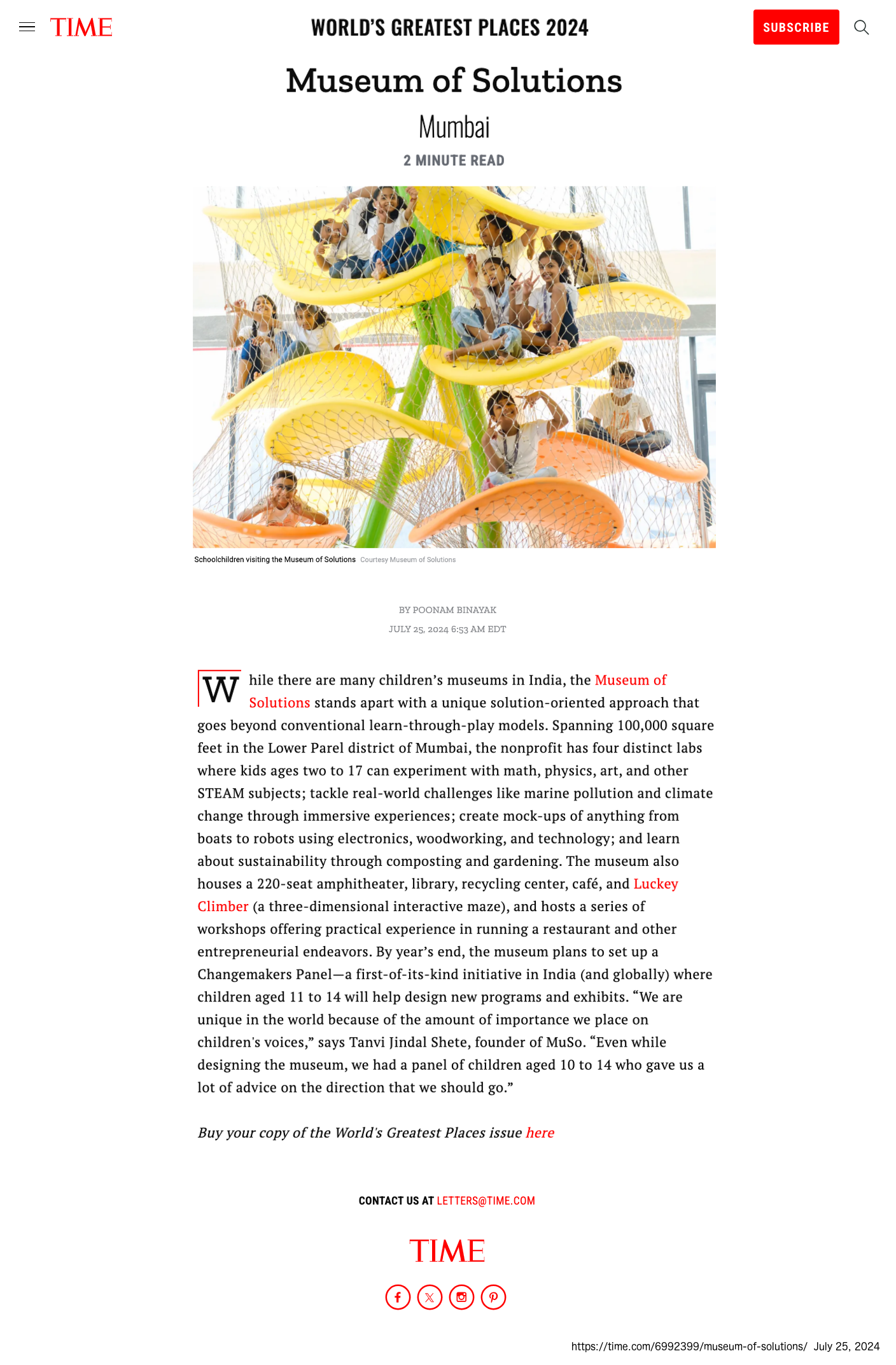
TIME names MuSo one of the World's 100 Greatest Places for 2024

TIME Magazine has named MuSo, the Museum of Solutions, one of the World's 100 Greatest Places for 2024.

Congratulations to my beloved (brave, visionary, foolhardy, loving, stubborn :) MuSo colleagues — and the kids and community who keep it real there, every day.

MuSo is in good company here. Fifty-one cultural and nature/heritage destinations in 31 countries are named in TIME's list, among them are the Putep ‘t-awt nature trail and whale observatory in Quebec, Canada; the Ivomo Tea Cooperative in Gisakura, Rwanda; and the Bab Al Salam Mosque in Muscat, Oman.

These are marvelous destinations indeed! But for my own part, as I've said before, I'm a little uncomfortable with these kinds of honors. They can feel arbitrary and superficial, and there are always hundreds of other extraordinary places, projects, and communities, all over the world, that will never get the recognition and support they deserve.

Also, as part of MuSo's founding team, I know our blind spots and skeletons-in-the-closet all too well: If only the reviewers knew too…LOL! My lips are sealed!

That being said, little winks of recognition like TIME's Greatest Places list provide a kind of validation that is incredibly useful to the teams and founders/funders who leap into the void, almost literally*, to start and sustain risky projects like MuSo.

It's scary — a vulnerable feeling — to create a startup venture of any kind, let alone one that seeks to reach so deeply, and so publicly, into the "now" and futures of young people. A billion decisions must be made, often quickly and in a vacuum of expertise and evidence, and it can be hard to tell which decisions are consequential or costly, right or wrong, until long after the moment has passed. Successes often feel quiet and fleeting, while mistakes can be public and harsh.

And a new concept like MuSo is an uncertain proposition for visitors and community too: What is this strange, new place? What will be expected of me? What will I do there? How will it make me feel?

So the editorial imprimatur of TIME — really every sliver of evidence that something new is heading in a good direction — really does help to give founders, funders, teams and communities some confidence that the bold new thing they're creating together makes sense at some level.

That's half the battle, as far as I'm concerned: to gain the confidence and resilience to keep working on hard things together ("Work that matters", as Tim O'Reilly once said), whether in the schoolyard, at the family dinner table, or on a global scale.

In a way, there's some symmetry in this equation. Some poetry too. Finding confidence and resilience is in the meta-purpose of MuSo: to help everyone keep working together — joyfully, purposefully, and playfully — until we get the good stuff right.

//

This post on LinkedIn (link)
TIME's 100 Greatest Places, 2024, MuSo: https://time.com/6992399/museum-of-solutions/
The whole list: https://time.com/collection/worlds-greatest-places-2024/

* During MuSo’s construction I almost stepped off a scaffolding into an open 9-story stairwell.

Leaving Mumbai

After 4 years on the project and a year as Director I’ve packed my bags and said goodbye, for now, to my fabulous friends, colleagues and community at the Museum of Solutions (MuSo), Mumbai. Thank you! I am overwhelmed by your kindness and generosity and I’ve learned more from you than you’ll ever know!

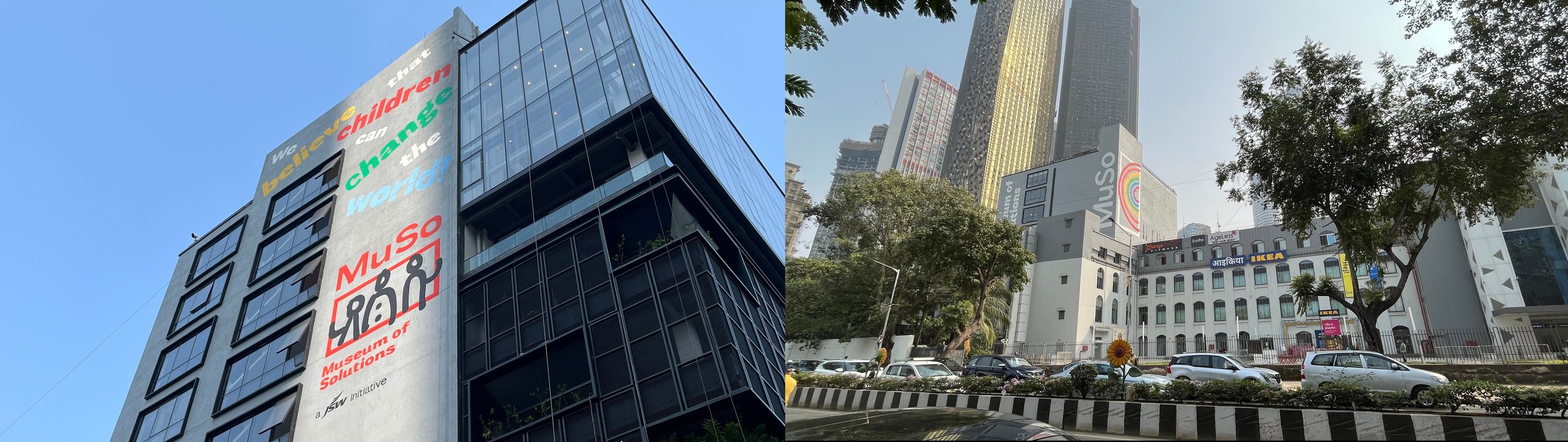
It was a privilege to help nurture this new museum and its library (LiSo, the Library of Solutions) from concept to reality; to help build and lead the founding team; and to welcome tens of thousands of visitors to our new state-of-the-art building — “a world-class space to champion the art of finding solutions,” as a reviewer at Condé Nast Traveler recently put it — unique in Mumbai and India, if not the world.

Four years ago Tanvi Jindal, MuSo’s founder, asked if I would help her think about a new “museum of solutions” she was envisioning for the site of an old industrial building in the middle of Mumbai.

How could we create a new kind of museum in one of the world’s largest and most challenging cities to catalyze action for the U.N. Sustainable Development Goals, foster new approaches to education, and help young people make meaningful change in the world together?

…And could we also make it fun?

Though Mumbai and India were new to me, this question of museums, play, and civic impact was not. Through years of work with the Smithsonian Institution, the U.N., and other cultural and civil-society conveners around the world I’ve been part of a decades-long movement to *flip the script* on traditional museum practice and help people use their own cultural institutions as platforms for the public good.

And this moment demands nothing less.

With a population of 22 million, Mumbai is indicative of the world’s 40+ megacities (cities with over 10 million inhabitants). Along with megacities like Shanghai, Jakarta, Paris, and L.A., Mumbai is home to daunting social and environmental problems — as well as astonishing creativity and drive. But the problems and the vitality often seem to live in different worlds.

Mumbai is India’s financial capital but over half of its residents live in slums. It is India’s innovation and creative hub (Bollywood! The city of dreams!) but many of its neighborhoods will be underwater by midcentury, drowned by rising seas due to climate change. Education is highly valued, but it is predominantly structured around rote memorization and test achievement, not the world as we see it today.

Young people are often caught in the middle of this dynamic, squeezed between a daily fight for survival, antiquated educational and social systems, and their own profound abilities to see and create a future filled with beautiful change.

Furthermore, young people — all people — have a fundamental human right to be involved in the decisions that will affect their futures, but too few conveners will help them find their way.

If we can learn to solve problems in places like Mumbai we stand a good chance of surviving and thriving in the 21st century. Museums like MuSo can be a kind of civic infrastructure in this regard. By being bold, inclusive, and action-oriented — rooted in reality but also participatory and fun — we can bring people together to build social capital and elevate everyone’s ability to imagine and build a future that is joyous, sustainable, and just.

What’s next for me? I don’t know — I’m still catching up on sleep and processing what I’ve learned! But with any luck, I’ll keep working in this direction: young people and their grownups in vital civic spaces, enthralled by the chance to play and explore together — making life better one small solution at a time.

//

This text is a slightly expanded version of this post on LinkedIn.

Announced today: Director of the Museum of Solutions, Mumbai (MuSo)

FOR IMMEDIATE RELEASE
Museum of Solutions, Mumbai
May 10, 2023

Today we are proud to announce the appointment of Michael Peter Edson as the Chief Museum Officer (museum director) of the Museum of Solutions. Edson, an internationally renowned museum professional, will be responsible for leading the museum’s mission to inspire and empower young people to solve the world’s most pressing problems.

“Mike has been a long-time friend and supporter of MuSo,” said Tanvi Jindal the museum’s Founder. “He is a visionary and empathetic leader with a passion for the social impact of museums. Mike’s creative drive and his deep commitment to the rights and capabilities of young people make him an ideal leader for our organization.”

With over 30 years of experience in museums, Edson has long been at the forefront of transformational change in the cultural sector. Edson was formerly the Director of Web and New Media Strategy for the Smithsonian Institution, the world’s largest museum and research complex in Washington, D.C., and he was the co-founder of the Museum for the United Nations - UN Live, where he forged a new vision to catalyze global effort towards the sustainable development goals of the U.N.. Edson is a frequent speaker on the topic of technology, culture, and social change, and he has been active as a consultant and collaborator in over 20 countries.

“MuSo is a groundbreaking initiative: full of global significance, but founded on a true love for the people and future of Mumbai,” said Edson. “The world is changing quickly and museums are changing too. Traditionally, museums have looked backward at the past through the eyes of a few experts — today, museums are looking toward the future, inspired to make a better world with and for the communities they serve. I am honored to be joining the Museum of Solutions at this important time.”

Mike will join the team full-time in August.

About MuSo

The Museum of Solutions (MuSo) is a new, state-of-the-art museum in Mumbai, India, dedicated to inspiring and empowering people to solve the world’s most pressing problems. MuSo’s exhibits and programs will explore a variety of topics, including climate change, poverty, and inequality through hands-on exploration and playful learning. The museum will open its new, purpose-built 100,000 square foot facility in the heart of Mumbai's Upper Parel district in 2023.
Press release, Museum of Solutions, May 10, 2023 (via LinkedIn)
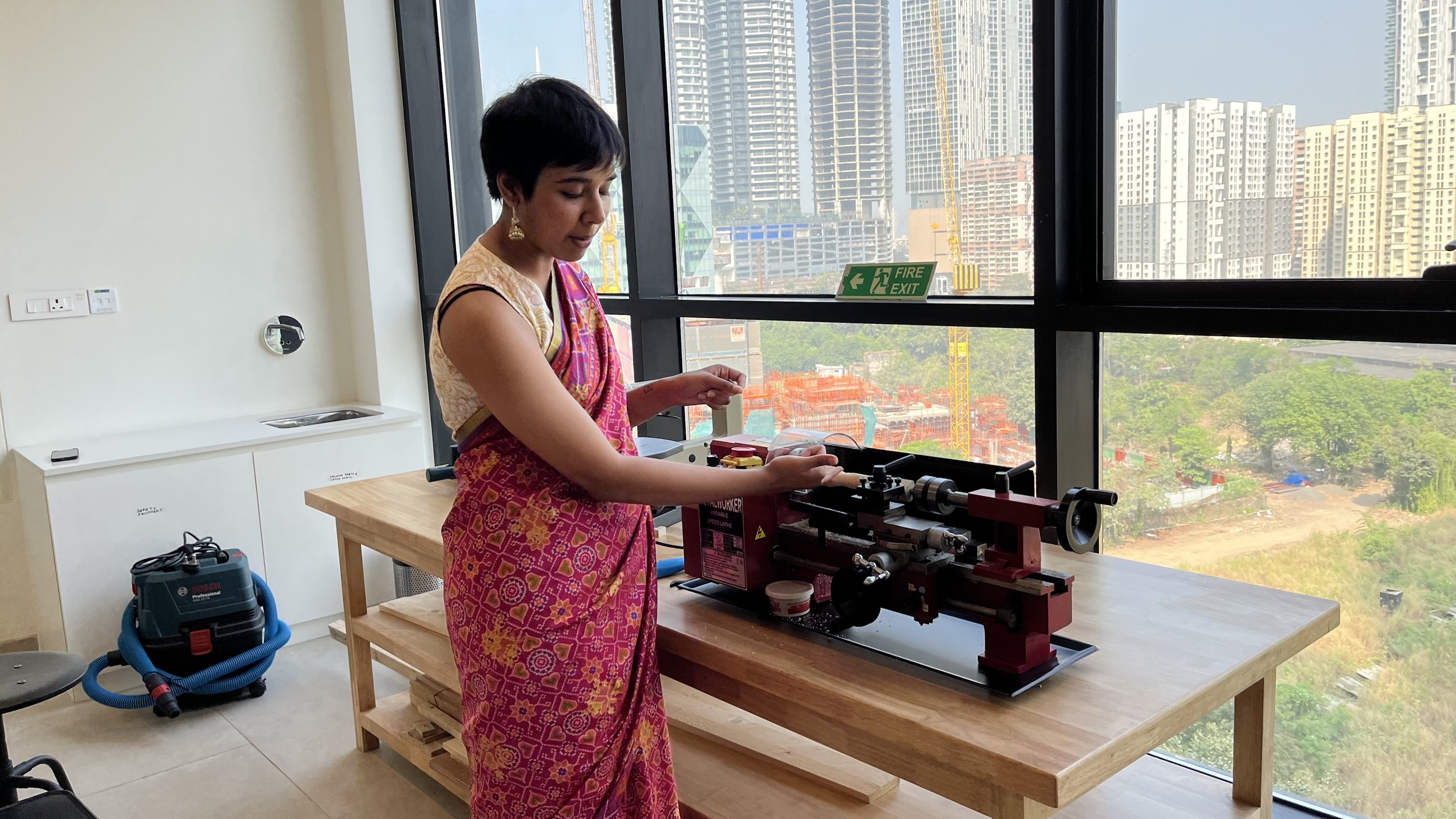
A small picture gallery about the museum is here (my photos).

MuseumNext Interview: Culture, activism, and the big Frikin' Wall

Jim Richardson and Tim Deakin published a long interview with me on the MuseumNext website in advance of the Green Museum Summit.

As a former Director of Web and New Media Strategy for the Smithsonian Institution and co-founder of the Museum of the United Nations – UN Live, Michael Peter Edson’s career has often been intertwined with the big issues over the last 30 years.

He explains to MuseumNext why the landscape has changed for museums and how passivity is no longer an option in the face of urgent issues like climate change. Instead, he advocates for new and dynamic forms of activism in order to have a “consequential impact on the course of the Anthropocene”.

Video and slides/links for NEMO webinar, Create Dangerously: Museums in the Age of Action

A quick post here with some links I’ll mention in tomorrow’s Feb. 14 Webinar for NEMO – the Network of European Museum Organizations: Create Dangerously: Museums in the Age of Action.

Video of the talk and Q&A

Slides: Google Slides / slides in a static PDF format

Recommended books/articles

Below are some of the books/articles I recommend towards the end of the talk, more-or-less in order of appearance.

Please get in touch if you have any questions or suggestions!

"Digitality" references for MuseumNext and Computers In Libraries

This week I’ll be speaking at the MuseumNext Green Museums Summit and Computers In Libraries (two separate conferences) about “digitality” and climate action in the cultural sector.

Here’s the gist of it: The climate emergency asks museums, libraries, and other heritage, knowledge, and memory institutions a series of tough questions about their purpose and relevance in society. How big can they work? Who do they involve? Who do they serve?

Compared to the scale and speed of the climate crisis and the mind-blowing scope of what we must accomplish together in the next 10, 20, and 30 years, what can the cultural sector do?

These questions are hard to discuss within the cultural sector. Though the humanistic, prosocial values in the sector are strong the sector’s institutions, in particular, are wary of disruption and have evolved to think in conservative, risk-averse ways. But the climate emergency acts like an X-ray or lie detector on institutional thinking, revealing gaps between values and practice that might go unnoticed when working on smaller concerns.

One of those gaps has to do with digital. Digital is currently a blind spot in our thinking about climate action, and in both of these talks I’ll argue that the museum and library sectors are operating with a confused and outdated concept of digitality that impedes our ability to think clearly about the kinds of impact we are obligated to create. An updated concept of what “digital” means in the 2020s — new tools, new skills (and learning to appreciate neglected old tools and skills) and a new understanding of the digital public sphere are all needed to help us find a new direction and unlock new capabilities within the sector and in the communities we serve.

But (or perhaps, and), going there — having a solid conversation about what digital is and can do requires us to question some tightly held assumptions about trust, disruption, and power.

Below are links to slides, references, and other useful/relevant information cited in the talks.

I’ll post slides transcripts from these talks ASAP.

Resources mentioned in the talks

Updates

General intro stuff from first 10 minutes

European climate and recovery initiatives

The European Commission has put €1.8 trillion on the table for the next 6 years’ work on The New European Bauhaus, pandemic recovery, and European Green Deal.

  • New European Bauhaus
    A new EU initiative launched in 2021 to be the cultural front-end for the European Green Deal. “The New European Bauhaus initiative calls on all of us to imagine and build together a sustainable and inclusive future that is beautiful for our eyes, minds, and souls. Beautiful are the places, practices, and experiences that are: Enriching, inspired by art and culture, responding to needs beyond functionality; Sustainable, in harmony with nature, the environment, and our planet; Inclusive, encouraging a dialogue across cultures, disciplines, genders and ages.”

  • Pandemic recovery
    €807 billion for 7 priority areas, including cohesion, resilience, natural resources/environment.

  • Green Deal
    Targets 55% reduction in greenhouse gas emissions by 2030, and by 2050: “economic growth decoupled from resource use”, carbon neutral, and “no person and no place left behind”.

Workshop notes (Digital, Culture, and the Transformation of Europe)

Farhad Manjoo: “A bag of mixed emotions”

Why Tech Is Starting to Make Me Uneasy, Farhad Manjoo, 11 October 2017.

“In 2007, when Mr jobs unveiled the iPhone, just about everyone greeted the new device as an unalloyed good. That's no longer true. The state-of-the-art, today, is a bag of mixed emotions. Check might improve everything. And it's probably all so terrible in ways we're only starting to understand.”

Reactions to Trump withdrawing the US from the Paris accord

Pew Research

I cranked through about 10 years of Pew Research Center reports in trying to figure out the evolution of our concept of digitality over the years. The first link, Visions of the Internet in 2035 | Pew Research Center, was particularly useful for gaining some insight into how “experts” conceptualize the role of information technology in society. That being said, I was dismayed, but not surprised, to see so few mentions of the climate emergency in any of these reports. Overall, these Pew reports reminded me of how essential and empowering the Internet is in so many people’s lives.

Here are a handful of the most useful reports. The full list is on this spreadsheet.

“Cataloging projects”

I put this spreadsheet together after reviewing 1000 pages of my own notes on digitality, 30+ reports from the Pew Research Center from the last 10 years, and notes from our November 2021 workshop on cultural-sector climate action.

There are three tabs

  • References lists 323 digital-related sites, apps, technologies, concepts, patterns, phenomena, and attributes that I’ve tagged, subjectively, with some adjectives like prosocial, civic, empowering, and dangerous.

  • Sorted by tag count shows each tag on its own column, and then a list of all the digital-related things that have that tag. You can hover your mouse over each cell to see a note and link (if there is one)

  • Link to sources shows a list of 89 articles, books, and references mentioned on the References tab

The empowering side of digitality

The Dark Side

Disruption Theory

Books, Articles, Videos

A big long list of relevant resources in this spreadsheet here, and a handful of the most relevant below.

17 examples of museum-ish social media for Alexandra Korey

Alexandra - -  here are some thoughts re: your question about examples of museum social media. (Posted here for easier sharing/linking and in case someone else was interested.)

Not a comprehensive list and not exclusively 2016, but perhaps useful/provocative. Note that I’m mostly interested in (and focusing on) examples that come from outside museums themselves.

1. Re: participation at scale, across the whole sector - - #askacurator@museumselfieday, #ilovemuseums - - via @mardixon (and see museumselfie info/paper here by Alli Burness http://museumselfies.tumblr.com/)

2. Re: giving control of the brand/trust relationship to users. @sweden - - http://www.newyorker.com/culture/culture-desk/the-pleasing-irreverence-of-sweden

3. Re: Civics/Governance in public institutions (demonstrating what is possible), “The Spanish Town That Runs On Twitter” http://www.nytimes.com/2016/06/09/technology/the-spanish-town-that-runs-on-twitter.html

4. Re: opening up to public interest in science, process, inquiry - - How to Tweet Like a Robot on Mars - - http://www.theatlantic.com/technology/archive/2014/10/how-to-tweet-like-a-robot-on-mars/381114/

5. Re: the relationship between global/local and not taking oneself too seriously, Orkney Library - - https://www.buzzfeed.com/alanwhite/real-talk-who-doesnt-dress-as-whitesnake-once-a-week [Note: Tumblr thinks the link is spam or evil, but it’s not, and it’s a good article. Copy/paste the URL into your browser.]

6. Re: cross-sector movement by museum staff - - #museumsRespondToFerguson. https://twitter.com/hashtag/museumsrespondtoFerguson?src=hash

7. Re: unusual and engaging telling of history - - @ReliveApollo11, real-time tweeting of ground/mission communication transcripts from original Apollo moon mission, from National Air and Space Museum (and in particular the numerous and poignant replies from the public)

8. Re: beautiful and surprising concepts, though not *exactly* social media, “Birdwatching” at the Rijksmuseum - - a meetup of birdwatching enthusiasts to tag/catalog images of birds in the Rijks collections. https://www.rijksmuseum.nl/en/vogelen and http://www.wis.ewi.tudelft.nl/research/wude/digital-birdwatching-at-the-rijksmuseum/

9. Re: working with communities - - the beautiful way that Dr Meghan Ferriter supports and encourages the Smithsonian Transcription Center community.

10. Re: museum collections speaking for themselves: Museum Bots - - https://twitter.com/backspace/lists/museum-bots/members

11. Re: initiatives supported by users/fans on their own - - #bookstagram on Instagram. https://www.instagram.com/explore/tags/bookstagram/?hl=en and http://bookriot.com/2013/06/07/a-brief-guide-to-bookstagram/

12. And Instagram in general…

13. And YouTube in general…

14: Re: Collecting/curating *outside* of official channels. Pinterest - - https://www.pinterest.com/search/?q=museum&referrer=sitelinks_searchbox

15. Re: soliciting stories/content from the public, The Museum of Broken Relationships. https://brokenships.com/

16. Re: artists speaking for themselves - - @aiww - - the artist on Twitter. “Twitter is the people’s tool, the tool of the ordinary people, people who have no other resources.” (A little more on http://usingdata.tumblr.com/post/88281521008/twitter-is-the-peoples-tool-the-tool-of-the)

17. …And an enormous shoutout/kudos to all the museums out there who are just being good - - good to their audiences and communities - - on social media. It’s not a sexy story, but it’s a great one, and maybe the one that matters the most. 

Ask Me Anything: Reddit AMA January 12

On January 12th I’ll be doing a Reddit AMA (Ask Me Anything) on MuseumPros, a group of over 1,800 museum professionals “dedicated to people who work in GLAMs (galleries, libraries, archives & museums).” 

Reddit.png

Update: post questions and follow along here.

I’ll be participating alongside my colleagues Ed Rodley and Emily Lytle-Painter. Blaire Moskowitz (aka Redpotato / @blaireMoskowitz) and Scott Chamness (aka Eistean) will moderate and answer questions too.

http://Reddit.com/r/MuseumPros

I think the general idea is that we’ll let questions accumulate and be upvoted through the middle of January 12th (in the North American time zones) then Ed, Emily, Scott, Blaire and I will really start engaging from mid-day onward. (I myself will be in and out of the AMA several times during the afternoon and into the night.)

If you have questions about the AMA or getting started with Reddit, please give us a shout!

Many thanks to Scott and Blaire, both for including me in this awesome event and for leading and sustaining MuseumPros over time. 

See you tomorrow.

Joining the UN Live Museum for Humanity

On January 1st I’ll be leaving the Smithsonian Institution to become part of the founding team for a new institution, the United Nations Live, Museum for Humanity, currently being envisioned for Copenhagen, Denmark. 

In addition to a physical building in Copenhagen, UN Live will include a global network of peer institutions, small and large scale programs, and, of course, a robust global digital presence. A UN resolution to charter the institution is currently under development in consultation with the Member States.

UNLive-logo.png

In my day-to-day work I’ll join Executive Director Jan Mattsson, Head of Secretariat Henrik Skovby, Project Director Jesper Lindhardt, Project Manager Emil Rostgaard Schelde, and Project Associates Anders Kjøller-Hansen and Oskar Harmsen. Artist Olafur Eliasson has played a key role in developing the creative concept for the institution, and many other remarkable people are contributing their time and expertise to the project. 

My primary responsibility for the next six months will be to help pull all of this expertise and creativity together, broaden the network of contributors, and refine the overarching scope and vision for the institution.

My working title will be Associate Director / Head of Digital, UN Live Museum. The project team is based in Copenhagen but I’ll stay on the East Coast of the USA for now.

UN Live is in its early phases, but Jan, Henrik, Jesper, Olafur and the rest of the team and community have done a jaw-droppingly spectacular job in bringing this concept from nothing to something tangible, inspiring, and worthy in a very short amount of time. I can only hope to do justice to their vision.

The vision of presenting art history on the terms set by the Internet had made good sense to us. It looked like the perfect medium for unfolding the paradigm of diversity. But then we came up against something that limited our options: copyright.
— Merete Sanderhoff, curator of digital practice at the National Gallery of Denmark, in Sharing is Caring: openness and sharing in the cultural heritage sector

Merete continues,

The costs were tremendously high. Just one image cost several hundred dollars, and that would only buy us clearance for a limited period of time. The labour involved in writing to each rights holder, asking for files, describing the intended usage, and so on, turned out to be a major drain on our manpower.