Slides and reference for Hands On! conference talk
I’m going to put my slides, references, and a transcript here ASAP!
Hands On! Conference at the Eureka! National Children’s Museum. Liverpool, UK. Nov 25-28, 2025.
I’m going to put my slides, references, and a transcript here ASAP!
Hands On! Conference at the Eureka! National Children’s Museum. Liverpool, UK. Nov 25-28, 2025.
A quick post here with some links I’ll mention in tomorrow’s Feb. 14 Webinar for NEMO – the Network of European Museum Organizations: Create Dangerously: Museums in the Age of Action.
Below are some of the books/articles I recommend towards the end of the talk, more-or-less in order of appearance.
The Carbon Almanac: https://thecarbonalmanac.org/
Minding the Climate: https://www.hup.harvard.edu/catalog.php?isbn=9780674247727
The Penguin Green Ideas series: https://shop.penguin.co.uk/products/penguin-green-ideas-collection
Business Disruption from the Inside Out: https://ssir.org/articles/entry/business_disruption_from_the_inside_out
Leverage Points: Places to Intervene in a System: https://donellameadows.org/archives/leverage-points-places-to-intervene-in-a-system/
Losing Earth: The Decade We Almost Stopped Climate Change https://www.nytimes.com/interactive/2018/08/01/magazine/climate-change-losing-earth.html
The Insect Apocalypse Is Here: https://www.nytimes.com/2018/11/27/magazine/insect-apocalypse.html
5 Minds for the Future: https://books.google.com/books/about/Five_Minds_for_the_Future.html
The Ministry for the Future: https://en.wikipedia.org/wiki/The_Ministry_for_the_Future
Leaving Microsoft to Change the World: https://www.harpercollins.com/products/leaving-microsoft-to-change-the-world-john-wood
Braiding Sweetgrass: https://milkweed.org/book/braiding-sweetgrass
Ways of Being: https://jamesbridle.com/books/ways-of-being
Think Big, Start Small, Move Fast: https://slideshare.net/edsonm
Legends & Lattes: https://en.wikipedia.org/wiki/Legends_%26_Lattes
Living Dead in Dallas: https://en.wikipedia.org/wiki/Living_Dead_in_Dallas
How to be a Craftivist: https://craftivist-collective.com/Paperback-How-To-Be-A-Craftivist+
Climate Things https://climatethings.org — sign up for the mailing list or volunteer to get involved. I’d love to hear from you!
Please get in touch if you have any questions or suggestions!
Just posted to /climate, a set of links and references for talks I’m giving this week at the MuseumNext Green Museums Summit and Computers in Libraries about a new concept of digitality to encourage climate action within the cultural sector.
https://www.usingdata.com/climate/2022/3/13/digitality-references-for-museumnext-cil
Just posted over in /climate, our report from Digital, Culture, and the Transformation of Europe, a climate-action strategy workshop I organized in Leiden in November.
I’ve just posted the report (slides here, and embedded above) from our climate-action strategy workshop Digital, Culture, and the Transformation of Europe, held on November 18-19, 2021 in Leiden, the Netherlands.
The goal of the workshop was to determine if, how, and to what degree the cultural sector (very broadly defined) can contribute meaningfully to the social, economic, and environmental transformations required by the climate emergency.
The word “culture” gets thrown around a lot in climate policy circles, and many of us, as cultural professionals, are outraged by the climate emergency and want to take action. But what can the cultural sector actually do for the climate fight?
Some clear themes emerged through our two-day workshop and the weeks of thinking and dialogue that followed. I’ll list a few below as a preview, as one does, but the depth and complexity of the ideas (and more) really come to life through the words of the participants themselves, as shown in the report.
The Big Frikin’ Wall — With a nod to the remarkable Kathy Sierra, much of the cultural sector seems afflicted by, metaphorically speaking, a Big Frikin’ Wall that stands between the world of safe, established practice and the world of urgent work that needs to be done. Working through, around, or over this wall will require a combination of strategic thinking, bold and enlightened management, well placed incentives. If we do not work through the Big Frikin’ Wall we are not likely to make significant progress on the climate emergency, as a sector or as a society. (See slide 38)
Local, bottom-up approaches — The importance of local, bottom-up action was a persistent theme throughout the workshop. Participants emphasized that they felt many organizations wanted to be more involved in campaigning, movement-making, and local action but don’t know how to start. Training in these techniques might be a smart investment for the sector. (See slide 56)
The role of culture — Participants offered a variety of opinions about the role of culture in society. Is “culture” a social good? A tool that serves power? An expression of identity? An entertainment medium? A tourist industry? A human right? The term culture is used in a variety of sometimes contradictory ways, even within the same sentence. A shared understanding of what we mean by “culture” would help us have more productive discussions about how to use it as a tool for positive change. (See slide 70)
Digitality — It is hard to imagine how we will win the climate fight without an enlightened and strategic use of digital platforms; and it is easy to imagine losing the climate fight if digital is ignored (or worse, subverted). But a concept of digitality — what it means to live in a society that is infused with digital — is notably absent from the cultural strategies emerging from initiatives such as the European Green Deal and the New European Bauhaus. The cultural sector must develop a concept of digitality to match its ambitions for participating in climate action or effecting social change. (See slide 69)
- - Note that I’ll be speaking about a new concept of digitality at Computers in Libraries and the MuseumNext Green Summit this month.
The need for solidarity — Workshop participant Tom Pravda, Co-founder of Avaaz, asserted that the social problems caused by the climate crisis may prove to be more of a problem than the climate crisis itself. “We need to be working in ways to build human solidarity — a sense that we are in this together,” stated Tom. “Only by cooperating are we going to be able to tackle this problem.” (See slide 17)
I am happy to say that a number of clear, actionable initiatives arose directly from this workshop, including a sector-wide training initiative, a proposal for Horizon Europe funding, and a radical “incentive prize” competition. These, in addition to the remarkable work already being done by workshop participants.
Concept development is underway for these new initiatives, and I’m also working to organize a follow-up meeting in Europe and similar workshops in the Americas, where the cultural-sector issues are different but the will to make a difference is likely to be the same.
Finally, as I’m writing this I’m aware that the COP26 conference in Glasgow was taking place as we were planning this workshop, and the IPCC’s grim sixth climate report was issued 2 days ago as I was finalizing the report. Meanwhile, the world is still afflicted by the COVID-19 pandemic and Russia has invaded Ukraine. If we believe that the cultural sector, however defined, has the potential to inspire and educate people, build solidarity, and transform lives for the better then there’s a lot of work to do.
Many thanks to everyone who participated (listed on slide 6), including our supporters and GoFundMe contributors who pitched in to defray travel and lodging expenses for participants. And of course many thanks to my co-conveners Meta Knol, Director of the Leiden 2022 European City of Science, and Harry Verwayen, Director of the Europeana Foundation, who stepped boldly into the void to help make this workshop a success.
Last week I gave a keynote for a convening of new grantees from the Kulturstiftung des Bundes / German Federal Cultural Foundation's Digital Fund, which just made an impressive award of €13.2m in grants to 15 projects by 32 organizations.
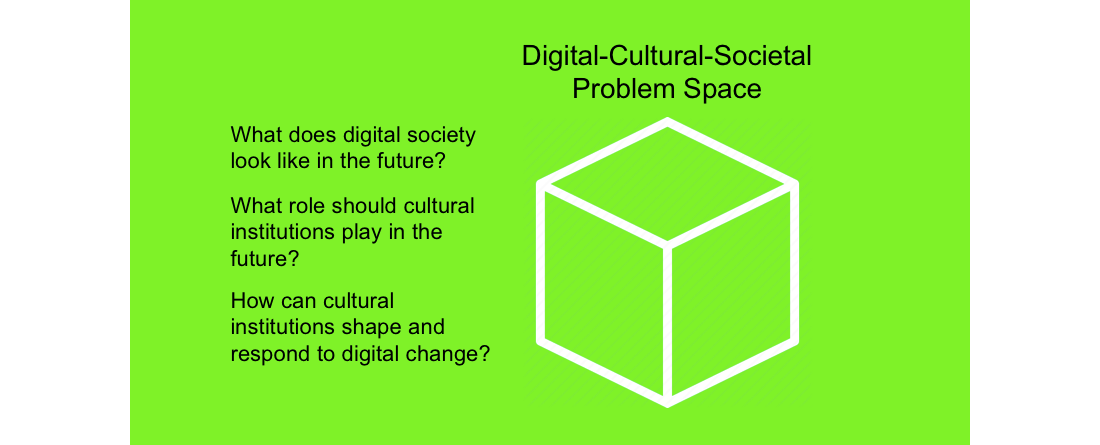
The talk addressed 3 main questions identified by the Digital Fund's director, Julia Mai.
What does digital society look like in the future?
What role should cultural institutions play in the future?
How can cultural institutions shape & respond to digital change?
Here are the slides, with annotations, references, and links: Digital Culture and the Shaking Hand of Change
In a later passage, Stengel continues,
From Jeff Bezos’ letter to shareowners [sic], 1997 annual report:
We don’t do PowerPoint (or any other slide-oriented) presentations at Amazon. Instead, we write narratively structured six-page memos. We silently read one at the beginning of each meeting in a kind of “study hall.” Not surprisingly, the quality of these memos varies widely. Some have the clarity of angels singing. They are brilliant and thoughtful and set up the meeting for high-quality discussion. Sometimes they come in at the other end of the spectrum.
[…]
The traditional kind of corporate meeting starts with a presentation. Somebody gets up in front of the room and presents with a powerpoint presentation, some type of slide show. In our view you get very little information, you get bullet points. This is easy for the presenter, but difficult for the audience. […] If you have a traditional ppt presentation, executives interrupt. If you read the whole 6 page memo, on page 2 you have a question but on on page 4 that question is answered.
Below, Amazon’s Vice President and Distinguished Engineer Brad Porter comments further in The Beauty of Amazon's 6-Pager, 2015:
The down side to the 6-pager is that writing a good six-page evidence-based narrative is hard work. Precision counts and it can be hard to summarize a complex business in 6 pages, so teams work for hours preparing the document for these reviews. But that preparation does two things.
First, it requires the team writing the document to really deeply understand their own space, gather their data, understand their operating tenets and be able to communicate them clearly. The second thing it does is a great document enables our senior executives to internalize a whole new space they may not be familiar with in 30 minutes of reading thus greatly optimizing how quickly and how many different initiatives these leaders can review.
My collaborator Dana Mitroff Silvers and I have received a grant from the Aspen Institute Tech Policy Hub, funded by the Ford Foundation and the Omidyar Network, to help museums, libraries, and performing arts organizations work more directly with their communities during this awful, challenging moment in America.
The Aspen Tech Policy Hub announcement and press release is here.
10 cultural organizations, together serving over 4 million people across the United States, have joined us.
Our partners are,
Arts & Minds, New York, New York (with Howes Studio), with Carolyn Halpin-Healy, Nellie Escalante, and Deborah Howes
Akron-Summit County Public Library System, Akron, OH, with Jennifer Stencel
Center for Art and Public Exchange, an initiative of the Mississippi Museum of Art, Jackson, MS, with Monique Davis
Georgia O'Keeffe Museum, Santa Fe, NM, with Liz Neely
Lux Art Institute, Encinitas, CA, with Andrew Utt and Claudia Cano
Mississippi Museum of Art, Jackson, MS, with McKenzie Drake
Newark Museum of Art, Newark, NJ, with Deborah Kasindorf and Silvia Flippini Fantoni
RED EYE Theater, Minneapolis, MN, with Emily Gastineau, Jeffrey Wells, and Rachel Jendrzejewski
Weisman Art Museum, Minneapolis, MN, with Katherine Covey and Susannah Schouweiler
The idea of this project is very humble and straightforward: Dana and I will bring the group together and provide workshops, facilitation, coaching, know-how, and outside perspectives; and the participants will bring their vast professional expertise, imagination, and intimate knowledge of their communities, missions, and values. We’ll meet weekly over the course of 10 weeks and together we’ll try to nudge new experiments and ideas into the light of day.
When we conceived this project back in April we were focused exclusively on addressing the harm being caused to communities and individuals by the social isolation of Covid-19, but April seems like it was 100 years ago. Now, with our hearts aching from the eruption of pain, fear, and anger of what we have all lived through and witnessed over the last few days here in the US, and with many of our collaborators dealing with the immediate consequences and long-term root causes of violence and injustice on their own doorsteps, we will inevitably be drawn together towards a larger and more consequential response.
I hope you will follow this project here, with the participants directly, on my Twitter and Dana’s Twitter — and I also hope that everyone, everywhere, will become more deeply committed to the social and cultural life, social justice, and wellbeing of their own communities.
P.S.
In addition to this Aspen project I’m also beginning to lead a series of sense-making workshops with Europeana Network members this week, with Jasper Visser, to help understand and support the digital transformation they are currently experiencing across the European cultural sector.
Also, we have launched a call for participation for What Matters Now, an online community event to be held on July 10, 2020 [was previously July 3]. Please check it out and join us!
Last week I put up a post offering free strategy workshops to help people, organizations, and teams in the “cultural” & civil-society sectors deal with the Covid-19 crisis.
Based on the response, here’s some stuff you can sign up for, using the form at the bottom.
(Note: I’m hosting this on my own site for now, because that’s fast and easy for me, but we’ll find a more neutral place to host and collaborate as more organizers get involved.)
A lot of people said they wanted a workshop, so I’m working with 9 different teams now in the USA and Europe. I’m swamped, but let me know if you’d like to talk.
A lot of people said they wanted to be part of a peer-to-peer discussion. In response, Jasper Visser and I are organizing and hosting a leadership roundtable next week (hi Jasper, I didn’t take the time to check this text with you. I hope that’s ok) — and I’d like to help organize similar facilitated sessions for anyone in the cultural sector (with “culture” interpreted as broadly and generously as possible). This will need both participants (hah!) and facilitators.
And I got the sense, as I often do, that there’s a lot of great thinking and doing happening that’s hard for us to see or appreciate, given how chaotic things are. So I’d like to facilitate/host a virtual Ignite talk event (or some similar short talks format) to beckon forth people who what to share what they’re working on or going through. This will need both volunteers to help host and organize, and, of course, brave, big-hearted people who want to share what’s on their minds.
* * * * * * * * *
If any of these options/things interests you, please let me know via the form below.
Final thought: the priorities here are,
First, stay safe and take care of our families loved ones, and communities
Support each other
Figure out how to serve now, at a moment of great civic need
The sign-up period has closed but I’m keeping the form below for reference. Thanks! - Mike
This will send me an email and I’ll enter it in a spreadsheet. If you don’t like that we can find another way to talk. I won’t share your info with anyone unless you give me permission to do so.
Questions with a “*” at the end are required.
This is a crosspost from my main site.
Over the last few days I’ve spent a lot of time thinking, and talking with organizers, leaders and practitioners in the cultural community, about how GLAMs (galleries, libraries, archives, museums) and community/civil-society organizations are coping with the Covid-19 crisis.
Most of us are in shock or reactive mode — closing down public spaces and caring for loved ones and neighbors.
But once the initial shock wears off (which hopefully, it will) and we’ve done what we can do easily in the realm of public service (for example, move programs to the web and promote online resources), we’re going to need to take a serious look at the role our organizations really play in society, and what we need to do differently in the short (next few weeks), medium (3-4 months), and long-term future (years) to make sure we’re doing justice to our missions and our communities.
With that in mind I’m offering some free strategy workshops for GLAMs and other public-facing community/civil-society organizations in the coming weeks.
Not that I have answers to teach you — far from it! I’m doing this because, as a trained facilitator with 25+ years experience in the digital cultural sector and a lot of international experience at a variety of scales, I think I can help teams and organizations find their own best strategies and solutions for this unsettling and difficult moment in time.
That’s what I’m trained to do. And I’m doing this because I can, and because I want to help, and because I believe in the value of what we do in the cultural sector and in civil society.
What I imagine is that you are a team within an organization like a museum, a library, a civil-society org. that faces the public. You could be the online or communications team, a leadership group, the board of directors, whatever. Or you’re an ad-hoc team from a movement like Fridays for Future. The important thing for me is that you have a civic mission, you face the public, and you want to create value in society, as they say.
You are hungry to dive deep, over the course of a day or two, into your mission, purpose, and identity — and to model through what those things mean now, in the world of Covid-19.
You’re curious to experiment with the LEGO Serious Play process — a facilitated thinking, communication, and problem-solving technique for groups — in a remote (online, distributed) teleconference setting. (The LEGO Serious Play process is optimized for face-to-face interaction, so moving it to a videoconference format is unorthodox and experimental.)
You want to start soon (as early as the week of March 23, 2020).
If that sounds interesting to you, or if you have any questions or suggestions, please get in touch with me through this form at the bottom of my “consulting” page. Tell me a little about who you are and what you’d like to do and I’ll get back to you ASAP.
Thanks!
P.S. If you want to leave a comment or question on this post, or make a suggestion, please ping me on twitter (@mpedson) or use this comment form here. I’ll review your comments/questions and respond, or post them here, as appropriate. :)
P.P.S English is my best language (though god knows I still struggle with it), but if you need to work in another language we’ll figure something out.
UPDATE (March 28, 2010, 11:45am EDT): there’s a new, follow-up post about free workshops, peer-to-peer roundtables, and “Ignite” talks here: https://www.usingdata.com/covid19/2020/3/26/register-here-to-participate-or-help
Over the last few days I’ve spent a lot of time thinking, and talking with organizers, leaders and practitioners in the cultural community, about how GLAMs (galleries, libraries, archives, museums) and community/civil-society organizations are coping with the Covid-19 crisis.
Most of us are in shock or reactive mode — closing down public spaces and caring for loved ones and neighbors.
But once the initial shock wears off (which hopefully, it will) and we’ve done what we can do easily in the realm of public service (for example, move programs to the web and promote online resources), we’re going to need to take a serious look at the role our organizations really play in society, and what we need to do differently in the short (next few weeks), medium (3-4 months), and long-term future (years) to make sure we’re doing justice to our missions and our communities.
With that in mind I’m offering some free strategy workshops for GLAMs and other public-facing community/civil-society organizations in the coming weeks.
Not that I have answers to teach you — far from it! I’m doing this because, as a trained facilitator with 25+ years experience in the digital cultural sector and a lot of international experience at a variety of scales, I think I can help teams and organizations find their own best strategies and solutions for this unsettling and difficult moment in time.
That’s what I’m trained to do. And I’m doing this because I can, and because I want to help, and because I believe in the value of what we do in the cultural sector and in civil society.
What I imagine is that you are a team within an organization like a museum, a library, a civil-society org. that faces the public. You could be the online or communications team, a leadership group, the board of directors, whatever. Or you’re an ad-hoc team from a movement like Fridays for Future. The important thing for me is that you have a civic mission, you face the public, and you want to create value in society, as they say.
You are hungry to dive deep, over the course of a day or two, into your mission, purpose, and identity — and to model through what those things mean now, in the world of Covid-19.
You’re curious to experiment with the LEGO Serious Play process — a facilitated thinking, communication, and problem-solving technique for groups — in a remote (online, distributed) teleconference setting. (The LEGO Serious Play process is optimized for face-to-face interaction, so moving it to a videoconference format is unorthodox and experimental.)
You want to start soon (as early as the week of March 23, 2020).
If that sounds interesting to you, or if you have any questions or suggestions, please get in touch with me through this form at the bottom of my “consulting” page. Tell me a little about who you are and what you’d like to do and I’ll get back to you ASAP.
Thanks!
P.S. If you want to leave a comment or question on this post, or make a suggestion, please ping me on twitter (@mpedson) or use this comment form here. I’ll review your comments/questions and respond, or post them here, as appropriate. :)
P.P.S English is my best language (though god knows I still struggle with it), but if you need to work in another language we’ll figure something out.
“A hedge against despair” lingers in the mind.
“One of the weaknesses of game theory as a way of thinking about the world is that it assumes we all know the rules of the game we’re playing. ”
Alexandra - - here are some thoughts re: your question about examples of museum social media. (Posted here for easier sharing/linking and in case someone else was interested.)
Not a comprehensive list and not exclusively 2016, but perhaps useful/provocative. Note that I’m mostly interested in (and focusing on) examples that come from outside museums themselves.
1. Re: participation at scale, across the whole sector - - #askacurator, @museumselfieday, #ilovemuseums - - via @mardixon (and see museumselfie info/paper here by Alli Burness http://museumselfies.tumblr.com/)
2. Re: giving control of the brand/trust relationship to users. @sweden - - http://www.newyorker.com/culture/culture-desk/the-pleasing-irreverence-of-sweden
3. Re: Civics/Governance in public institutions (demonstrating what is possible), “The Spanish Town That Runs On Twitter” http://www.nytimes.com/2016/06/09/technology/the-spanish-town-that-runs-on-twitter.html
4. Re: opening up to public interest in science, process, inquiry - - How to Tweet Like a Robot on Mars - - http://www.theatlantic.com/technology/archive/2014/10/how-to-tweet-like-a-robot-on-mars/381114/
5. Re: the relationship between global/local and not taking oneself too seriously, Orkney Library - - https://www.buzzfeed.com/alanwhite/real-talk-who-doesnt-dress-as-whitesnake-once-a-week [Note: Tumblr thinks the link is spam or evil, but it’s not, and it’s a good article. Copy/paste the URL into your browser.]
6. Re: cross-sector movement by museum staff - - #museumsRespondToFerguson. https://twitter.com/hashtag/museumsrespondtoFerguson?src=hash
7. Re: unusual and engaging telling of history - - @ReliveApollo11, real-time tweeting of ground/mission communication transcripts from original Apollo moon mission, from National Air and Space Museum (and in particular the numerous and poignant replies from the public)
8. Re: beautiful and surprising concepts, though not *exactly* social media, “Birdwatching” at the Rijksmuseum - - a meetup of birdwatching enthusiasts to tag/catalog images of birds in the Rijks collections. https://www.rijksmuseum.nl/en/vogelen and http://www.wis.ewi.tudelft.nl/research/wude/digital-birdwatching-at-the-rijksmuseum/
9. Re: working with communities - - the beautiful way that Dr Meghan Ferriter supports and encourages the Smithsonian Transcription Center community.
10. Re: museum collections speaking for themselves: Museum Bots - - https://twitter.com/backspace/lists/museum-bots/members
11. Re: initiatives supported by users/fans on their own - - #bookstagram on Instagram. https://www.instagram.com/explore/tags/bookstagram/?hl=en and http://bookriot.com/2013/06/07/a-brief-guide-to-bookstagram/
12. And Instagram in general…
13. And YouTube in general…
14: Re: Collecting/curating *outside* of official channels. Pinterest - - https://www.pinterest.com/search/?q=museum&referrer=sitelinks_searchbox
15. Re: soliciting stories/content from the public, The Museum of Broken Relationships. https://brokenships.com/
16. Re: artists speaking for themselves - - @aiww - - the artist on Twitter. “Twitter is the people’s tool, the tool of the ordinary people, people who have no other resources.” (A little more on http://usingdata.tumblr.com/post/88281521008/twitter-is-the-peoples-tool-the-tool-of-the)
17. …And an enormous shoutout/kudos to all the museums out there who are just being good - - good to their audiences and communities - - on social media. It’s not a sexy story, but it’s a great one, and maybe the one that matters the most.
Everything you need to know about global vs. local scale, in one image. (Dave Berg, Mad Magazine, 1956)
My talk about the UN Live Museum for Humanity at TEDxTysons.
“A third advantage of mission oriented companies is that people outside the company are more willing to help you. You’ll get more support on a hard, important project, than a derivative one. When it comes to starting a startup, it’s easier to found a hard startup than an easy startup. This is one of those counter-intuitive things that takes people a long time to understand. It’s difficult to overstate how important being mission driven is, so I want to state it one last time: derivative companies, companies that copy an existing idea with very few new insights, don’t excite people and they don’t compel the teams to work hard enough to be successful.”