
“[Public Sector Information] is the single largest source of information in Europe. Its estimated market value is €27 billion. Re-used, this public data could generate new businesses and jobs and give consumers more choice and more value for money.”
“YouTube is an amazing demonstration of the power of this principle, a true open, bottom-up media marketplace that is the closest thing we’ve seen to the “whuffie” based economy of Cory Doctorow’s first book, Down and Out in the Magic Kingdom.”
“I bet there are as many people making a living on YouTube as in the iTunes app store, yet there’s far less buzz about it.”
Haka (by Ben Hall)
Publish first, then curate

This post by Tim O’Reilly initially caught my eye for two reasons,
Tim is using Google+ as a micro blogging platform, somewhere in between Twitter and his O’Reilly Radar blog.
In the post he riffs on YouTube as an economy
Whoever it was who said that the internet model turns traditional media on its head, from curate then publish to publish first, then curate, surely got it right
There’s a new advertising business model here too. With hundreds of millions of views, these bands are now media companies. It seems to me that the potential of YouTube to be a game changer in the media marketplace, a powerful new channel and business model for artists is still not widely understood. I bet there are as many people making a living on YouTube as in the iTunes app store, yet there’s far less buzz about it.
I hadn’t heard that phrase about the change from “curate then publish” to “publish first, then curate” before, but it’s powerful.
(I find myself thinking specifically about the presentation by SchoolTube that Darren Milligan facilitated a few weeks ago—there seems to be a huge demand for B-roll, stock footage of everything and anything that can be re-used by students and teachers. During the SchoolTube presentation we discussed the nuances between our reflexive approach to content creation (curation) with a B-roll approach. One statement by SchoolTube president Carl Arizpe stands out in my mind, (paraphrase) “We have students and teachers clamoring for B-roll footage of the Washington Monument. They can’t find anything that’s rights-free or licensed for re-use.”)
How Web Video Powers Global Innovation
Chris Anderson: How web video powers global innovation, recorded July 2010.
There are a few ideas in this talk by TED founder Chris Anderson (not Wired Magazine editor Chris Anderson) that are, as the conference says, worth spreading.
1) The concept of Crowd Accelerated Innovation (at 5:50)
[QUOTE] And there are just three things you need for this [crowd accelerated innovation] thing to kick into gear. You can think of them as three dials on a giant wheel. You turn up the dials, the wheel starts to turn. And the first thing you need is … a crowd, a group of people who share a common interest. The bigger the crowd, the more potential innovators there are. That’s important, but actually most people in the crowd occupy these other roles. They’re creating the ecosystem from which innovation emerges. The second thing you need is light. You need clear, open visibility of what the best people in that crowd are capable of, because that is how you will learn how you will be empowered to participate. And third, you need desire. You know, innovation’s hard work. It’s based on hundreds of hours of research, of practice. Absent desire, not going to happen.
2) Openness (6:55)
This is how TED survives and thrives by GIVING EVERYTHING AWAY:
[QUOTE] So, at TED, we’ve become a little obsessed with this idea of openness. In fact, my colleague, June Cohen, has taken to calling it “radical openness,” because it works for us each time. We opened up our talks to the world, and suddenly there are millions of people out there helping spread our speakers’ ideas, and thereby making it easier for us to recruit and motivate the next generation of speakers. By opening up our translation program, thousands of heroic volunteers – some of them watching online right now, and thank you! – have translated our talks into more than 70 languages, thereby tripling our viewership in non-English-speaking countries. By giving away our TEDx brand, we suddenly have a thousand-plus live experiments in the art of spreading ideas. And these organizers, they’re seeing each other, they’re learning from each other. We are learning from them. We’re getting great talks back from them. The wheel is turning.
3) “Jove” (10:32) a video scientific journal to increase speed/efficiency of knowledge transfer between scientist
This need/idea was entirely new to me and it knocked me off my feet:
[QUOTE] Jove [http://www.jove.com/About.php?sectionid=1] is a website that was founded to encourage scientists to publish their peer-reviewed research on video. There’s a problem with a traditional scientific paper. It can take months for a scientist in another lab to figure out how to replicate the experiments that are described in print. Here’s one such frustrated scientist, Moshe Pritsker, the founder of Jove. He told me that the world is wasting billions of dollars on this. But look at this video. I mean, look: if you can show instead of just describing, that problem goes away. So it’s not far-fetched to say that, at some point, online video is going to dramatically accelerate scientific advance.
4) Global, mobile, video-driven education (15:01)
If you’re like me you’ll suffer, grinding your teeth through a bit of hyperbole at 15:01 - - but be patient, it’s a setup. You’ll be wowed by the Pakistan and Kenya example that follow:
[QUOTE] Here’s a group of kids in a village in Pakistan near where I grew up. Within five years, each of these kids is going to have access to a cellphone capable of full-on web video and capable of uploading video to the web. I mean, is it crazy to think that this girl, in the back, at the right, in 15 years, might be sharing the idea that keeps the world beautiful for your grandchildren? It’s not crazy; it’s actually happening right now.
I want to introduce you to a good friend of TED who just happens to live in Africa’s biggest shantytown.
(Video) Christopher Makau: Hi. My name is Christopher Makau. I’m one of the organizers of TEDx Kibera. There are so many good things which are happening right here in Kibera. There’s a self-help group. They turned a trash place into a garden. The same spot, it was a crime spot where people were being robbed. They used the same trash to form green manure. The same trash site is feeding more than 30 families. We have our own film school. They are using Flip cameras to record, edit, and reporting to their own channel, Kibera TV. Because of a scarcity of land, we are using the sacks to grow vegetables, and also [we’re] able to save on the cost of living. Change happens when we see things in a different way. Today, I see Kibera in a different way. My message to TEDGlobal and the entire world is: Kibera is a hotbed of innovation and ideas.
I think TED has been walking the talk with crowd accelerated innovation for years now and I’ve been fascinated watching its website evolve towards a sharing and collaboration platform even though its core product is video that you consume. I intend to steal the design patterns for embedding, favoriting, sharing, downloading, transcripts (including crowd created transcripts and translations), and rating for the Smithsonian Commons. These features didn’t appear overnight though, they seem to have accrued gradually over time.
Organizations that get > 1M hours/year of community effort
I’m starting some research into organizations that might get > 1 million hours/year of volunteer effort through their websites (and, of course, mobile sites/apps). This comes directly from a conversation some colleagues and I had last week with new Smithsonian National Board member Dave Kidder, co-founder and CEO of clickable.com.
I think this - - directly or indirectly catalyzing large amount of effort towards Work That Matters - - should be one of the goals (link to project wiki) of the Smithsonian Commons project: 100 million items in the commons, 100 million user interactions a year, and a million hours of community effort a year - - all by the fifth year. Let’s set the bar high, shall we.
I want to understand how they get it (whatever “it” is) to work, how it started, how to support and nurture it, and how to measure it. And a whole bunch of other questions I haven’t thought of yet…
So far, with the help of some smarties on Twitter, I’ve got,
- wikipedia
- ancestry.com
- openstreetmaps.org
- Trove (lots of active users transcribing scans of newspapers)
- www.freebase.com (via @jonvoss)
- librarything (via @jonvoss, @blclark)
- Galaxy Zoo (via @ambrouk, @ageekmom)
- Digitalkoot (via @mia_out)
- Recaptcha (via @charlotteshj)
- i-spot, “Nature surveys and activities near you” (via @ambrouk)
- OldWeather and the Milky Way Project at Zooniverse (via @Timh01)
- [updates below, as they roll in via Twitter and email]
- CamClicker, "Help us sort and tag our 8 million archived NestCam images.“ (Via @darrenMilligan)
Also of interest
Who else?
[frack! Gotta figure out how to enable commenting!]
[Oh, got it. That was odd and not well documented! You should see a "comment” link below, but not on the mobile view, yet.]
Update [November 22, 2011]
Merete Sanderhoff has posted research on these efforts to the Smithsonian Web and New Media Strategy Wiki.
Improv Everywhere
The Mp3 Experiment Eight (by ImprovEverywhere)
Boingboing says: “Charlie Todd says: “3,500 people downloaded the same mp3 from our website and pressed play simultaneously along the Hudson River in Lower Manhattan. What resulted was a massive silent party with glow sticks, camera flashes, and flashlights.”
One of the youtube comments says:
”I drove 600 miles from Cincinnati with 3 cars full of 5 people and we had the best day of our life! Thanks ImprovEverywhere!“
How Much Do Music Artists Earn Online? →

Infographic showing how many sales or downloads an artist needs every month to make minimum wage. (Example, an artist would need to have 4,053,110 streams a month on Spotify to make $1,160 in income.)
https://informationisbeautiful.net/2010/how-much-do-music-artists-earn-online/
This was mentioned on TWIT episode 310
Walking Papers →

Print maps, draw on them, scan them back in and help OpenStreetMap improve its coverage of local points of interests and street detail. Walking Papers is a product of Stamen Design’s Michal Migurski.
Update [February 3, 2018]: Walking Papers has become Field Papers. http://fieldpapers.org/
A thermometer or a thermostat
“I’ll put it this way, brother: You’ve got to be a thermostat rather than a thermometer. A thermostat shapes the climate of opinion; a thermometer just reflects it. If you’re just going to reflect it and run by the polls, then you’re not going to be a transformative president. Lincoln was a thermostat. Johnson and F.D.R., too.”
Shirky, on institutional change
“Running an organization is difficult in and of itself, no matter what its goals. Every transaction it undertakes—every contract, every agreement, every meeting—requires it to expend some limited resource: time, attention, or money. Because of these transaction costs, some sources of value are too costly to take advantage of. As a result, no institution can put all its energies into pursuing its mission; it must expend considerable effort on maintaining discipline and structure, simply to keep itself viable. Self-preservation of the institution becomes job number one, while its stated goal is relegated to number two or lower, no matter what the mission statement says. The problems inherent in managing these transaction costs are one of the basic constraints shaping institutions of all kinds. [p29]
…New social tools are altering this equation by lowering the costs of coordinating group action. The easiest place to see this change is in activities that are too difficult to be pursued with traditional management but that have become possible with new forms of coordination.” [p31]”
“Urgency is becoming increasingly important because change is shifting from episodic to continuous. With episodic change, there is no one big issue such as making and integrating the largest acquisition in a firm’s history. With continuous change, some combination of acquisitions, new strategies, big IT projects, reorganizations, and the like comes at you in an almost ceaseless flow…Put simply, a strong sense of urgency is moving from an essential element in big change programs to an essential asset in general”
Innovator's Dilemma
“…Leading firms’ most profitable customers generally don’t want, and indeed initially can’t use, products based on disruptive technologies. By and large, a disruptive technology is initially embraced by the least profitable customers in a market. Hence, most companies with a practiced discipline of listening to their best customers and identifying new products that promise greater profitability and growth are rarely able to build a case for investing in disruptive technologies until it is too late.”
Looking boldly into the future


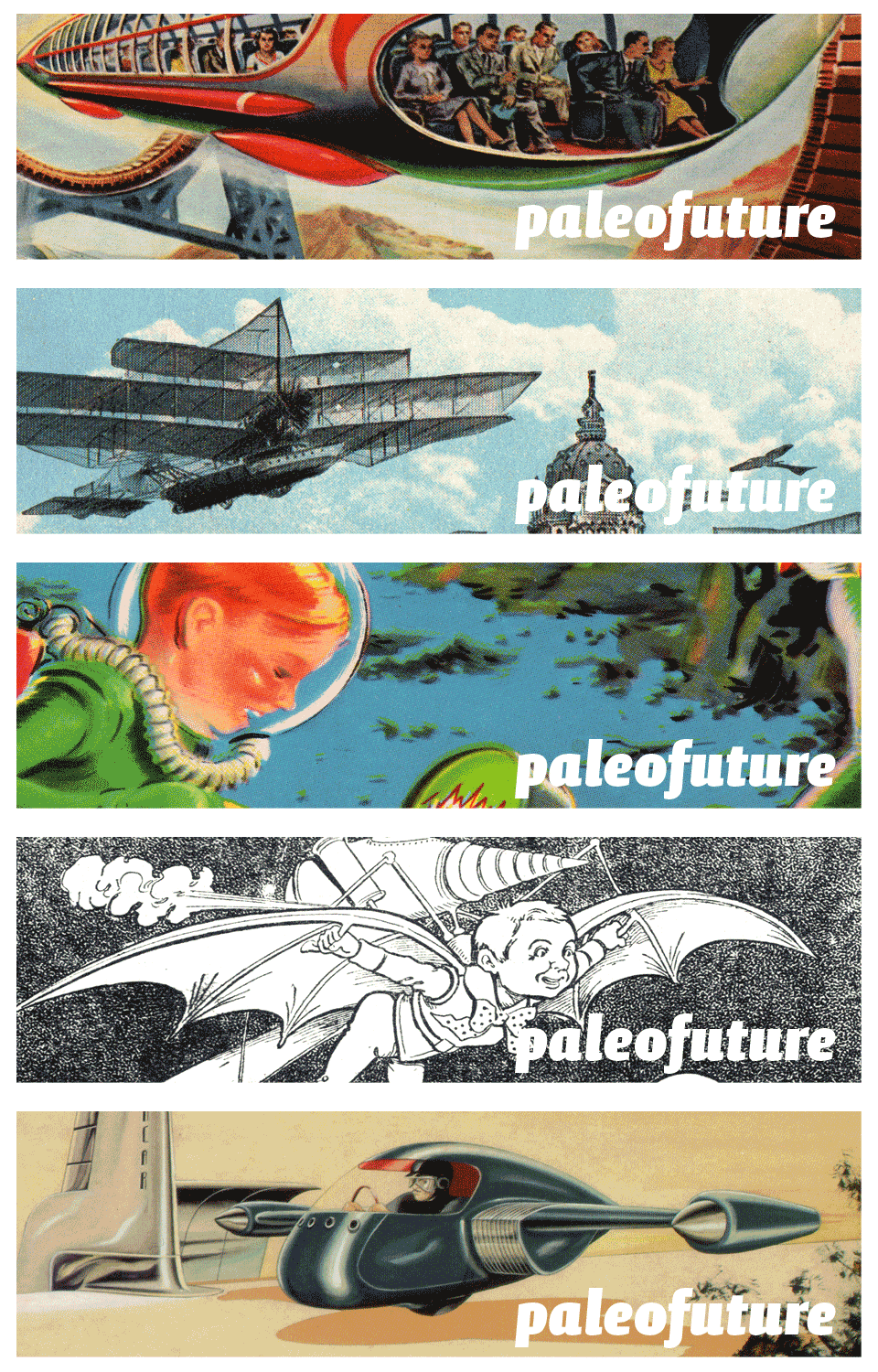


I asked Twitter for help finding an image to represent people looking boldly into the future. Responses are below. Thanks everyone!!!!
via @charlotteshj, "I’m sure this amazing blog may inspire - phps even have some futuristic pics http://paleofuture.com"
via @nealstimler,
R. Kent’s “Eternal Vigilance Is the Price of Liberty" http://t.co/Iwx5WQx
Prometheus Unchained http://t.co/hwVr7Pm @americanart
Pino Janni’s "Waterfront Scene" http://t.co/RrIpeYP
Thomas Delbridge’s "Lower Manhattan" http://t.co/6l03HJo #1934 @americanart
via @Anne6fy, "migrant photos, e.g. http://t.co/nhkkiSR"
via @lkchr, "supplementing @MSanderhoff ’s nice suggestion, there are also some fine pics of spectators admiring US a-bomb testing in the 50’s"
via @doug_burke
via @vanessafox
- If copyright doesn’t matter, then http://vigilantcitizen.com/wp-content/uploads/2009/10/Wizard-of-Oz-Emerald-City.jpg, if it does, then (hmm..) http://www.flickr.com/photos/44025224@N06/4295975670
via @LukeSnarl, http://www.tagg.org/pix/snog2000.jpg
via @kos2, "Image of Alice looking through the keyhole? Dorothy opening up the door and seeing Munchkinland?"
via @spellboundblog, "Have you tried hunting over on the Flickr Commons? I used this one in a recent talk: http://www.flickr.com/photos/35740357@N03/4012382360"
via @chrisfreeland, "forward facing or back facing (the people, I mean)?"
via @msanderhoff, "If you like the odd ironic twist you could go for Soviet social realism from the 50'es-60'es"
via @anya1anya, "try Goog Image search of Balboa reaching the Pacific Ocean"
- - - - - - image credits - - - - - - -
Vasco Núñez de Balboa first sights the Pacific Ocean. Illustration by Tancredi Scarpellihttp://www.lookandlearn.com/blog/?p=1228
Paleofuture banner imagehttp://www.paleofuture.com/blog/category/1980s
Burrough Audubon Society Members Use Binoculars to Identify Migratory Shore Birds…02/1975The U.S. National Archives, No known rights restrictionshttp://www.flickr.com/photos/usnationalarchives/4012382360/in/photostream/
CD artwork by Chris Woods for Snogg’s album "Third Mall from the Sun” (2000)http://www.tagg.org/pix/snog2000.jpg
Untitled oz imagehttp://vigilantcitizen.com/wp-content/uploads/2009/10/Wizard-of-Oz-Emerald-City.jpg
Looking Ahead… by Nebraska Helen, CC - Attributionhttp://www.flickr.com/photos/44025224@N06/4295975670
Eternal Vigilance Is the Price of Liberty1945, Rockwell Kenthttp://americanart.si.edu/collections/search/artwork/?id=13583
Prometheus Unchained1938, Rockwell Kenthttp://americanart.si.edu/collections/search/artwork/?id=13594
Pino Janni: Waterfront Scene, 1934CC - Attribution, noncommercial, no derivativeshttp://www.flickr.com/photos/americanartmuseum/3266744205/in/pool-1046782@N22/
Thomas James Delbridge: Lower Manhattan, 1934CC - Attribution, noncommercial, no derivativeshttp://www.flickr.com/photos/americanartmuseum/3266713733/in/pool-1046782@N22/
Fail fast, fail often
These people crank through about 5 iterations of a RC airplane design in a couple of hours using foam core, toothpicks, and packing tape.
When people talk about “fail fast, fail often” in the web design world, this is what we’re talking about.
JSNES: A JavaScript NES emulator – Ben Firshman

This appears to be a page dedicated to game system emulators written in javascript.
The mobile web



Rethinking the Mobile Web, https://www.slideshare.net/bryanrieger/rethinking-the-mobile-web-by-yiibu
Smithsonian Commons Prototype
https://www.si.edu/commons/prototype